[SE-0466] Control default actor isolation inference
이 글은 Swift Evolution 제안서 원문과 포럼 리뷰 스레드를 Claude Code 로 정리한 글이다. 코드는 Xcode 27 의 Swift 6.4 컴파일러로 빌드하고, 진단 메시지와 실행 결과는 실제로 컴파일하고 실행해서 나온 것을 옮겼다.
제안서 정보
- 번호: SE-0466
- 상태: Implemented (Swift 6.2)
- upcoming feature flag: 없음 (컴파일러 옵션
-default-isolation과 SwiftPM 의defaultIsolation설정으로 켠다) - 저자: Holly Borla, Doug Gregor
- 리뷰 매니저: Steve Canon
- Vision: Improving the approachability of data-race safety
- pitch: Pitch: Control default actor isolation inference (2025-01-27)
- 리뷰: Review (2025-03-05 부터 03-19 까지)
- 수락: Accepted (2025-03-29)
- 수정안 pitch: Pitch: Amend SE-0466 + SE-0470 to improve isolation inference (2025-05-13)
- 수정안 리뷰: Amendment: SE-0466 (2025-07-09 부터 07-15 까지, 신속 리뷰)
- 수정안 수락: Accepted amendment to SE-0466 (2025-08-18)
- 전제 제안서: SE-0449 (
nonisolated를 타입에 붙이는 문법), SE-0412 (전역 변수의 strict concurrency), SE-0434 (global actor 타입의 사용성)
한 줄 요약
모듈 하나를 통째로 main actor 에 두는 모드가 생겼다. 컴파일러 옵션 -default-isolation MainActor (SwiftPM 에서는 .defaultIsolation(MainActor.self)) 를 주면, isolation 을 따로 적지 않은 선언이 nonisolated 대신 @MainActor 로 추론된다. 단일 스레드로 짠 앱 코드가 data-race 오류를 내는 일을 줄이려는 모드이고, 기본값은 지금까지와 같은 nonisolated 다. 이 글은 어떤 선언에 @MainActor 가 붙고 어떤 선언은 그대로 남는지를, 컴파일러에 직접 물어서 정리한다.
어떤 문제였나
SE-0466 은 새 문법이 아니라 새 기본값이다. 그래서 먼저 “기본값이 왜 문제였는가” 부터 본다. Swift 6 언어 모드에서 isolation 을 적지 않은 코드는 nonisolated 다. 이 기본값은 동시성을 쓰는 코드에는 맞지만, 동시성을 쓰지 않는 코드에는 오류를 만든다.
이 글의 뼈대는 이렇다. 문제를 두 가지로 나눠서 컴파일러 진단으로 보고, 바뀌는 것을 모듈 단위 설정, 추론 규칙, init 과 deinit, 클로저, nonisolated 로 빠져나가는 법, 프로토콜 conformance, Sendable 을 물려받는 프로토콜, override 순서로 측정한다. 그다음 포럼 스레드 여섯 개를 따라가고, 소스 호환과 마이그레이션을 본다.
앞 글들의 내용은 짧게 짚고 간다.
- SE-0449 글:
nonisolated를 타입과 extension 에 붙여서 global actor 추론을 막는 문법. 이 글의nonisolated로 빠져나가기가 이 문법이다 - SE-0412 글: 전역 변수와 static 변수가
Sendable이거나 global actor 에 묶여야 한다는 규칙 - SE-0434 글: global actor 에 묶인 타입을 쓰기 쉽게 만든 변경
- SE-0461 글: nonisolated
async함수가 어디서 도는지를 정한 제안. 이 글의 where 실험에서 같이 켠다
main actor 에서 도는 앱 코드
앱을 만들 때 코드의 대부분은 main actor 에서 돈다. SwiftUI 의 View, UIKit 의 UIViewController 같은 UI 타입이 이미 @MainActor 이고, 이 타입을 쓰는 코드도 같이 main actor 로 끌려 들어가기 때문이다. 동시성을 일부러 쓴 적이 없는 코드가 @MainActor 와 nonisolated 의 경계를 만나면, 그때부터 isolation 이라는 개념을 알아야 한다. 제안서 Motivation 은 이 상황을 “main actor 위에서만 도는 코드가 false positive 오류를 낸다” 고 묶고 다섯 가지 예를 든다. 전역과 static 변수, nonisolated 프로토콜을 채택한 main actor 타입의 conformance, 클래스의 deinit, nonisolated 슈퍼클래스 메서드의 override, SDK 의 main actor API 호출이다. 이 글의 실험은 이 다섯 가지를 모두 포함한다.
이 글의 진단 명령
이 글의 진단은 모두 -emit-sil 로 뽑았다. -emit-sil 은 타입 검사 뒤 SIL(컴파일러 중간 표현) 단계까지 컴파일해서 그 단계의 진단까지 낸다. 타입 검사까지만 하는 -typecheck 는 SIL 단계의 진단(초기화 검사, region 검사)을 빼먹는다. 아래 명령에서 -o /dev/null 은 결과 파일을 버리고, -parse-as-library 는 최상위 코드가 없는 일반 소스 파일로 다루라는 옵션이며, -wmo 는 모든 파일을 한 모듈로 같이 컴파일하게 한다. 이 옵션들의 자세한 이야기는 SE-0423 글에 있다.
1
xcrun swiftc -emit-sil -o /dev/null -parse-as-library -wmo -swift-version 6 Motivation.swift
main actor 모드로 컴파일하는 판은 같은 명령에 -default-isolation MainActor 만 더한다. 이 글에서 “기본” 이라고 하면 Swift 6 언어 모드에 아무 옵션도 더하지 않은 판이고, “MainActor 모드” 라고 하면 이 옵션을 더한 판이다. 컴파일러는 Apple Swift version 6.4 (swiftlang-6.4.0.34.1) 이다.
1
xcrun swiftc -emit-sil -o /dev/null -parse-as-library -wmo -swift-version 6 -default-isolation MainActor Motivation.swift
첫 번째 예는 전역 변수와 static 변수다. 최상위 코드가 없는 파일에서, 이름 그대로 읽으면 아무 문제가 없어 보이는 코드다.
Motivation.swift
1
2
3
4
5
6
7
8
9
10
var counter = 0

struct Settings {
  static var theme = "light"
}

func bump() {
  counter += 1
  Settings.theme = "dark"
}
counter 는 전역 변수이고 Settings.theme 은 static 변수다. bump() 는 이 둘을 고치기만 한다. 스레드를 만든 적도 없고 Task 를 쓴 적도 없다. 기본 Swift 6 모드의 진단이다.
1
2
3
4
5
6
7
8
9
10
11
12
13
14
15
16
17
18
19
20
21
22
Motivation.swift:1:5: error: var 'counter' is not concurrency-safe because it is nonisolated global shared mutable state [#MutableGlobalVariable]
 1 | var counter = 0
   |     |- error: var 'counter' is not concurrency-safe because it is nonisolated global shared mutable state [#MutableGlobalVariable]
   |     |- note: convert 'counter' to a 'let' constant to make 'Sendable' shared state immutable
   |     |- note: add '@MainActor' to make var 'counter' part of global actor 'MainActor'
   |     `- note: disable concurrency-safety checks if accesses are protected by an external synchronization mechanism
 2 |
 3 | struct Settings {

Motivation.swift:4:14: error: static property 'theme' is not concurrency-safe because it is nonisolated global shared mutable state [#MutableGlobalVariable]
 2 |
 3 | struct Settings {
 4 |   static var theme = "light"
   |              |- error: static property 'theme' is not concurrency-safe because it is nonisolated global shared mutable state [#MutableGlobalVariable]
   |              |- note: convert 'theme' to a 'let' constant to make 'Sendable' shared state immutable
   |              |- note: add '@MainActor' to make static property 'theme' part of global actor 'MainActor'
   |              `- note: disable concurrency-safety checks if accesses are protected by an external synchronization mechanism
 5 | }
 6 |

[#MutableGlobalVariable]: <https://docs.swift.org/compiler/documentation/diagnostics/mutable-global-variable>
[exit 1]
두 변수 모두 “nonisolated 전역 공유 가변 상태라서 concurrency-safe 가 아니다” 라는 오류다. 컴파일러가 제안하는 길은 세 개다. let 으로 바꿔서 불변으로 만들거나, @MainActor 를 붙여서 main actor 에 넣거나, 외부 동기화로 지킨다고 약속하고 검사를 끈다. 동시성을 쓴 적이 없는 코드에게 이 세 길은 모두 낯설다. 가운데 길인 @MainActor 가 현실적인데, 문제는 이 속성이 전파된다는 점이다. bump() 가 counter 를 고치려면 bump() 도 main actor 에 있어야 하고, bump() 를 부르는 함수도 그래야 한다.
같은 코드를 MainActor 모드로 컴파일하면 오류가 없다.
1
[exit 0]
counter, Settings.theme, bump() 가 모두 @MainActor 로 추론되어서, 서로 같은 isolation 이니 전파할 것이 없다. 코드는 한 글자도 바꾸지 않았다.
SE-0412 의 규칙은 언어 모드에 따라 오류의 강도가 다르다. 같은 파일을 세 모드로 컴파일한 결과다.
1
2
3
4
5
6
7
=== Motivation.swift [-swift-version 5]
=== Motivation.swift [-swift-version 5 -strict-concurrency=complete]
Motivation.swift:1:5: warning: var 'counter' is not concurrency-safe because it is nonisolated global shared mutable state; this is an error in the Swift 6 language mode [#MutableGlobalVariable]
Motivation.swift:4:14: warning: static property 'theme' is not concurrency-safe because it is nonisolated global shared mutable state; this is an error in the Swift 6 language mode [#MutableGlobalVariable]
=== Motivation.swift [-swift-version 6]
Motivation.swift:1:5: error: var 'counter' is not concurrency-safe because it is nonisolated global shared mutable state [#MutableGlobalVariable]
Motivation.swift:4:14: error: static property 'theme' is not concurrency-safe because it is nonisolated global shared mutable state [#MutableGlobalVariable]
Swift 5 모드는 아무 말도 하지 않고, -strict-concurrency=complete 를 주면 경고를 내며 그 경고가 “Swift 6 언어 모드에서는 오류” 라고 알려 준다. Swift 6 모드에서 오류가 된다. SE-0466 이 겨냥하는 쪽은 이 마지막 모드다. 동시성을 쓰지 않는 단일 스레드 코드가 Swift 6 의 완전한 검사를 거쳐야 할 때의 비용을 줄이려는 것이다.
@MainActor 를 적어도 남는 오류
@MainActor 를 손으로 붙이는 방법은 어떨까. 앞의 첫 번째 예는 붙이면 풀리지만, 두 번째 예는 붙여도 풀리지 않는다. nonisolated 프로토콜을 채택한 main actor 타입이다.
Conformance.swift
1
2
3
4
5
6
7
8
9
protocol Describable {
  func describe() -> String
}

@MainActor
final class Counter: Describable {
  var count = 0
  func describe() -> String { "count = \(count)" }
}
Describable 은 아무것도 붙이지 않은 프로토콜이고, Counter 는 @MainActor 클래스다. Counter.describe() 는 클래스를 따라 @MainActor 이므로, nonisolated 요구사항을 만족시킬 수 없다. 기본 Swift 6 모드의 진단이다.
1
2
3
4
5
6
7
8
9
10
11
12
13
14
15
16
Conformance.swift:6:22: error: conformance of 'Counter' to protocol 'Describable' crosses into main actor-isolated code and can cause data races [#ConformanceIsolation]
 4 |
 5 | @MainActor
 6 | final class Counter: Describable {
   |                      |- error: conformance of 'Counter' to protocol 'Describable' crosses into main actor-isolated code and can cause data races [#ConformanceIsolation]
   |                      |- note: isolate this conformance to the main actor with '@MainActor'
   |                      `- note: turn data races into runtime errors with '@preconcurrency'
 7 |   var count = 0
 8 |   func describe() -> String { "count = \(count)" }
   |        |- note: main actor-isolated instance method 'describe()' cannot satisfy nonisolated requirement
   |        `- note: mark instance method 'describe()' 'nonisolated'
 9 | }
10 |

[#ConformanceIsolation]: <https://docs.swift.org/compiler/documentation/diagnostics/conformance-isolation>
[exit 1]
오류의 문장은 “Counter 의 Describable conformance 가 main actor 격리 코드로 넘어가서 data race 가 날 수 있다” 이고, 노트가 고칠 길을 둘 준다. @MainActor 로 conformance 자체를 main actor 에 가두거나(SE-0470 의 isolated conformance), @preconcurrency 로 검사를 런타임으로 미루거나, 메서드를 nonisolated 로 만드는 길이다. 앞의 둘은 새 개념이 둘 더 필요하고, 마지막은 메서드 본문이 count 를 읽을 수 없게 만든다.
코드에 나온 것
SE-0470 은 isolated conformance 를 정한 제안이다. @MainActor 가 붙은 타입이 nonisolated 프로토콜을 채택하면서 “이 conformance 는 main actor 안에서만 쓸 수 있다” 고 선언하게 한다. 자세한 규칙은 SE-0470 글에서 다룬다. 이 conformance 를 자동으로 @MainActor 에 두는 upcoming feature 가 InferIsolatedConformances 다.
MainActor 모드로 컴파일하면 이 오류도 사라진다.
1
[exit 0]
프로토콜 Describable 도 @MainActor 로 추론되어서(프로토콜은 뒤에서 본다), 요구사항과 구현이 같은 isolation 이 된다. 오류가 사라진 이유가 “검사를 껐다” 가 아니라 “양쪽이 같은 isolation 이 되었다” 라는 점이 중요하다. 이 글에서는 이 차이를 계속 따라간다. InferIsolatedConformances 만 켠 판도 위 코드에서는 오류가 없다.
1
[exit 0]
이 feature 는 @MainActor 타입의 conformance 를 자동으로 isolated conformance 로 만들어서 같은 코드를 통과시킨다. 이 두 길은 효과가 같아 보이지만, 모듈 전체에 무슨 일이 생기는지는 다르다. 뒤의 “프로토콜과 conformance” 절에서 isolated conformance 를 nonisolated 문맥에서 쓰면 어떤 오류가 나는지 본다.
무엇이 바뀌나
SE-0466 이 더하는 것은 두 가지다. 컴파일러 옵션 -default-isolation 과, 같은 일을 하는 SwiftPM 설정 defaultIsolation 이다. 이 위에 “isolation 을 적지 않은 선언” 이 어떻게 추론되는지의 규칙이 따른다.
모듈 단위 기본 isolation
옵션은 두 값만 받는다. 기본값은 nonisolated 이고 선택지는 MainActor 다.
Flag.swift
1
func f() {}
먼저 MainActor 를 주었을 때다. 선언의 isolation 은 -print-ast 로 찍어서 본다.
1
xcrun swiftc -print-ast -swift-version 6 -default-isolation MainActor Flag.swift
1
2
@MainActor internal func f() {
}
f() 에 @MainActor 가 붙었다. 값에 = 를 써서 -default-isolation=MainActor 로 주어도 같다.
1
2
@MainActor internal func f() {
}
같은 옵션으로 엉뚱한 값을 주면 컴파일러가 거부한다.
1
2
<unknown>:0: error: invalid value 'MyActor' in '-default-isolation MyActor'
[exit 1]
1
2
<unknown>:0: error: invalid value 'mainactor' in '-default-isolation mainactor'
[exit 1]
사용자 정의 global actor 를 쓰는 길은 없고, 대소문자도 구분한다. 값은 MainActor 와 nonisolated 둘뿐이다. 값 둘을 모두 주면 어떻게 되는지도 확인했다. 오류는 없고 뒤에 준 값이 이긴다. MainActor 를 먼저, nonisolated 를 나중에 주면 f() 에 아무것도 안 붙는다.
1
xcrun swiftc -print-ast -swift-version 6 -default-isolation MainActor -default-isolation nonisolated Flag.swift
1
2
internal func f() {
}
순서를 바꿔서 nonisolated 를 먼저, MainActor 를 나중에 주면 @MainActor 가 붙는다.
1
xcrun swiftc -print-ast -swift-version 6 -default-isolation nonisolated -default-isolation MainActor Flag.swift
1
2
@MainActor internal func f() {
}
SwiftPM 에서는 타깃 단위로 설정한다. tools version 6.2 부터 쓸 수 있는 SwiftSetting.defaultIsolation 이고, 값은 MainActor.self 와 nil 둘이다. 라이브러리 타깃과 실행 타깃이 나뉜 패키지를 만들었다. 라이브러리 타깃 Core 는 설정이 없고, 실행 타깃 App 만 MainActor 로 둔다.
Package.swift
1
2
3
4
5
6
7
8
9
10
11
12
13
14
15
// swift-tools-version: 6.2
import PackageDescription

let package = Package(
  name: "Pkg",
  platforms: [.macOS(.v15)],
  targets: [
    .target(name: "Core"),
    .executableTarget(
      name: "App",
      dependencies: ["Core"],
      swiftSettings: [.defaultIsolation(MainActor.self)]
    ),
  ]
)
Core 는 일부러 아무 설정도 하지 않은 타깃이다.
Sources/Core/Core.swift
1
2
3
4
5
6
7
8
public func checksum(_ bytes: [UInt8]) -> Int {
  bytes.reduce(0) { $0 &+ Int($1) }
}

public final class Cache {
  public var items: [String] = []
  public init() {}
}
App 의 두 파일이다. 전역 변수 theme 은 @MainActor 가 필요한 선언이다.
Sources/App/Settings.swift
1
2
3
4
5
var theme = "light"

func localChecksum(_ bytes: [UInt8]) -> Int {
  bytes.reduce(0) { $0 &+ Int($1) }
}
Sources/App/main.swift
1
2
3
4
5
6
7
8
9
10
11
12
13
import Core

theme = "dark"

@concurrent func work() async -> Int {
  checksum([1, 2, 3])
}

@concurrent func localWork() async -> Int {
  await localChecksum([1, 2, 3])
}

print(theme, await work(), await localWork())
work() 와 localWork() 는 @concurrent 로 main actor 밖에서 돌게 했다. localWork() 는 await 가 필요한데, localChecksum 이 App 모듈 안에서 main actor 로 추론되어서 main actor 밖에서 부르는 호출이 되기 때문이다. 빌드하고 실행한 결과다.
1
2
swift build
swift run App
1
2
Build complete!
dark 6 6
swift build -v 로 컴파일러 호출을 보면 -default-isolation MainActor 가 -module-name App 호출에만 붙고 Core 에는 붙지 않는다. 설정은 그 타깃 하나에만 적용된다는 뜻이다. Core.swift 끝에 전역 변수 한 줄을 더해서 확인했다.
1
public var hits = 0
Core 는 기본값이 nonisolated 라서 Swift 6 의 전역 변수 규칙이 그대로 걸린다. App 의 theme 은 같은 모양인데 통과했다.
1
2
3
4
5
6
7
8
9
10
11
Sources/Core/Core.swift:9:12: error: var 'hits' is not concurrency-safe because it is nonisolated global shared mutable state [#MutableGlobalVariable]
 7 |   public init() {}
 8 | }
 9 | public var hits = 0
   |            |- error: var 'hits' is not concurrency-safe because it is nonisolated global shared mutable state [#MutableGlobalVariable]
   |            |- note: convert 'hits' to a 'let' constant to make 'Sendable' shared state immutable
   |            |- note: add '@MainActor' to make var 'hits' part of global actor 'MainActor'
   |            `- note: disable concurrency-safety checks if accesses are protected by an external synchronization mechanism
10 |

[#MutableGlobalVariable]: <https://docs.swift.org/compiler/documentation/diagnostics/mutable-global-variable>
이 절의 포인트는 “모듈” 이다. 한 타깃에 설정을 주면 그 타깃의 모든 소스 파일이 같은 모드가 되고, 다른 타깃이나 의존하는 라이브러리는 영향을 받지 않는다. 포럼에서 파일 단위 설정을 바란 사람이 여럿 있었는데, 제안서는 이것을 Future direction 으로 남기고 CompilerSettings pitch 를 연결한다.
nil 은 기본값 nonisolated 를 명시하는 값이다. .defaultIsolation(nil) 로 바꾸고 빌드하면 컴파일러에 -default-isolation nonisolated 가 전달되고, theme 의 오류가 되살아난다.
1
2
3
4
5
6
7
Sources/App/Settings.swift:1:5: error: var 'theme' is not concurrency-safe because it is nonisolated global shared mutable state [#MutableGlobalVariable]
1 | var theme = "light"
  |     |- error: var 'theme' is not concurrency-safe because it is nonisolated global shared mutable state [#MutableGlobalVariable]
  |     |- note: convert 'theme' to a 'let' constant to make 'Sendable' shared state immutable
  |     |- note: add '@MainActor' to make var 'theme' part of global actor 'MainActor'
  |     `- note: disable concurrency-safety checks if accesses are protected by an external synchronization mechanism
2 |
이 API 는 tools version 이 6.2 보다 낮으면 쓸 수 없다. // swift-tools-version: 6.1 로 내렸을 때의 오류다.
1
2
3
4
5
6
7
8
9
Package.swift:12:24: error: 'defaultIsolation' is unavailable
10 |       name: "App",
11 |       dependencies: ["Core"],
12 |       swiftSettings: [.defaultIsolation(MainActor.self)]
   |                        `- error: 'defaultIsolation' is unavailable
13 |     ),
14 |   ]

PackageDescription.SwiftSetting.defaultIsolation:3:22: note: 'defaultIsolation' was introduced in PackageDescription 6.2
Xcode 에서는 build setting SWIFT_DEFAULT_ACTOR_ISOLATION (표시 이름 “Default Actor Isolation”) 이 같은 일을 한다. Xcode 27 의 Swift.xcspec 에서 이 설정은 nonisolated 와 MainActor 중에서 고르는 값이고, 기본값은 nonisolated, MainActor 를 고르면 컴파일러에 -default-isolation=MainActor 를 전달한다. 설명문은 이 설정이 순차 코드에서 나는 data-race 안전 오류의 false positive 를 줄이려는 것이라고 적는다. 새 앱 프로젝트 템플릿(App Base.xctemplate)은 이 값을 MainActor 로 켜 놓고, 프로젝트 기본 설정 템플릿(Base_ProjectSettings.xctemplate)은 SWIFT_VERSION = 5.0 과 SWIFT_APPROACHABLE_CONCURRENCY = YES 를 같이 둔다. SWIFT_APPROACHABLE_CONCURRENCY 는 DisableOutwardActorInference, GlobalActorIsolatedTypesUsability, InferIsolatedConformances, InferSendableFromCaptures, NonisolatedNonsendingByDefault 다섯 feature 를 한꺼번에 켜는 설정이다. 새 프로젝트가 이 설정을 켠 채로 나온다는 사실이 뒤의 스레드 절에서 다시 나온다.
언어 모드와의 관계도 짚어 둔다. -default-isolation MainActor 는 Swift 5 모드에서도 쓸 수 있다. Swift 5 모드에서 추론된 선언은 @preconcurrency 가 같이 붙는다.
1
2
@MainActor @preconcurrency internal func f() {
}
(ast.sh 는 -swift-version 6 을 먼저 주는데, 뒤에 준 -swift-version 5 가 이긴다.)
추론 규칙
MainActor 모드에서 무엇에 @MainActor 가 붙는지가 이 제안의 가장 큰 부분이다. 제안서는 규칙을 “isolation 을 적지 않은 선언에 @MainActor 를 추론한다” 로 시작해서, 예외를 하나씩 단다. 규칙부터 그림으로 보고, 하나씩 측정한다.
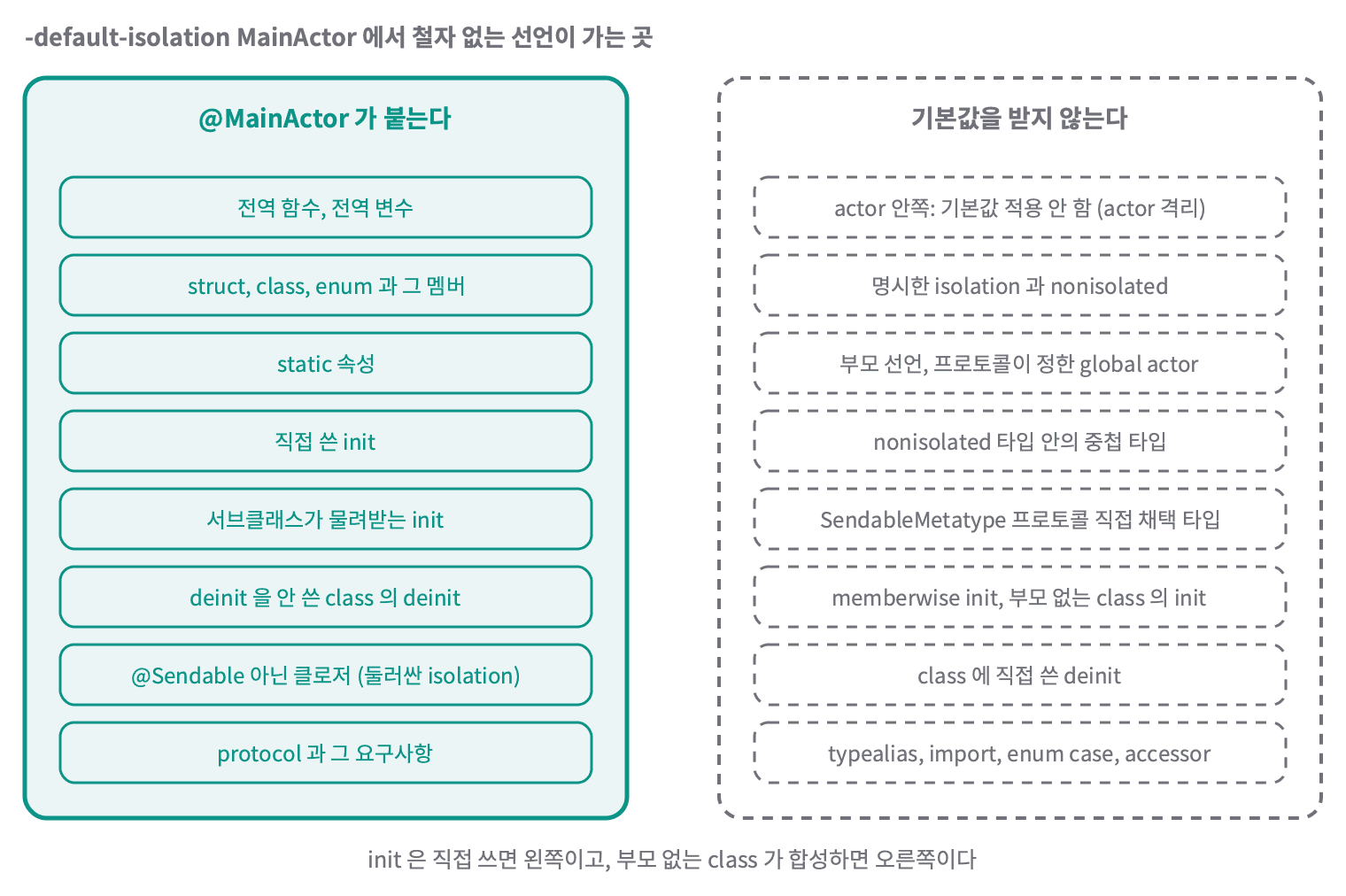
왼쪽 칸이 @MainActor 가 붙는 선언이고 오른쪽 점선 칸이 기본값을 받지 않는 선언이다. 제안서가 이 규칙을 보이려고 쓴 예제 코드를 컴파일해서 컴파일러의 판단을 -print-ast 로 찍었다.
ProposalExample.swift
1
2
3
4
5
6
7
8
9
10
11
12
13
14
15
16
17
18
19
20
21
22
23
24
25
26
27
28
29
30
31
32
33
34
35
36
37
38
39
40
41
42
43
44
45
46
47
func f() {}

class C {
  init() {}

  deinit {}

  struct Nested {
    func g() {}
  }

  static var value = 10
}

@globalActor
actor MyActor {
  init() {}

  deinit {}

  static let shared = MyActor()
}

@MyActor
protocol P {}

struct S: P {
  func f() {}
}

nonisolated protocol Q: Sendable {}

struct S2: Q {
  struct Inner {
    func g() {}
  }

  struct IsolatedInner: P {
    func g() {}
  }
}

struct S3 {
  func h() {}
}

extension S3: Q {}
이 코드는 규칙 여러 개를 한 파일에 모았다. C 는 일반 클래스, MyActor 는 사용자 정의 global actor, P 는 그 global actor 에 묶인 프로토콜, Q 는 nonisolated 와 Sendable 을 가진 프로토콜이다. MainActor 모드에서 컴파일러가 판단한 결과다.
1
xcrun swiftc -print-ast -swift-version 6 -default-isolation MainActor ProposalExample.swift
1
2
3
4
5
6
7
8
9
10
11
12
13
14
15
16
17
18
19
20
21
22
23
24
25
26
27
28
29
30
31
32
33
34
35
36
37
38
39
40
41
42
43
44
45
46
47
48
49
50
51
52
53
54
55
56
57
58
59
60
61
62
63
64
65
66
67
68
69
70
71
72
73
74
75
76
77
78
@MainActor internal func f() {
}

@MainActor internal class C {
  @MainActor internal init() {

  }
  @objc deinit {
  }
  @MainActor internal struct Nested {
    @MainActor internal func g() {
    }
    nonisolated internal init() {

    }
  }
  @MainActor @_hasInitialValue internal static var value: Int = 10
}

@globalActor internal actor MyActor {
  internal init() {

  }
  @objc deinit {
  }
  @_hasInitialValue internal static let shared: MyActor = MyActor()
  internal typealias ActorType = MyActor
  @_semantics("defaultActor") nonisolated final internal var unownedExecutor: UnownedSerialExecutor {
    get {
      return UnownedSerialExecutor(buildDefaultActorExecutorRef(self))
    }
  }
}

@MyActor internal protocol P {
}

@MyActor internal struct S : P {
  @MyActor internal func f() {
  }
  nonisolated internal init() {

  }
}

nonisolated internal protocol Q : Sendable {
}

internal struct S2 : Q {
  internal struct Inner {
    internal func g() {
    }
    internal init() {

    }
  }
  @MyActor internal struct IsolatedInner : P {
    @MyActor internal func g() {
    }
    nonisolated internal init() {

    }
  }
  internal init() {

  }
}

@MainActor internal struct S3 {
  @MainActor internal func h() {
  }
  nonisolated internal init() {

  }
}

extension S3 : Q {
}
진단은 [exit 0] 로 깨끗하다.
1
[exit 0]
위의 출력을 규칙별로 읽는다.
f()와C는@MainActor다. 철자 없는 전역 함수와 클래스의 기본 규칙이다.C.init()은@MainActor이고,C.value도@MainActor다. 직접 쓴init과 static 변수에도 규칙이 적용된다.C.Nested도@MainActor이고 그 안의g()도 그렇다. 바깥 타입이nonisolated가 아니므로 중첩 타입도 기본 규칙을 받는다.Nested의 합성init은nonisolated로 찍힌다.MyActor는 actor 라서 안쪽에는 기본값이 적용되지 않는다.init,deinit,shared에 아무 속성도 없다. 제안서의 규칙 “actor 안의 선언은 추론하지 않는다” 다. 메서드와 프로퍼티는 어떻게 되는지 아래에서 따로 본다.P는@MyActor이고,P를 채택한S는@MyActor가 되었다. 프로토콜에서 global actor 를 물려받으면 기본값은 쓰이지 않는다.S.f()도@MyActor다.Q는nonisolated프로토콜이다.Q를 채택한S2와 그 안의Inner는 아무 속성도 없는nonisolated로 남았다.Sendable을 상속하는 프로토콜을 채택하면 기본값이 꺼진다. 이 규칙이 수정안의 내용이고 뒤의 절에서 따로 본다.S2.IsolatedInner는P를 채택해서@MyActor다. 중첩 타입이nonisolated타입 안에 있어도 자기가 채택한 프로토콜의 global actor 를 가진다.S3는@MainActor이고S3.h()도 그렇다. 본문에서는Q를 채택하지 않았기 때문이다. 같은 파일 아래쪽의extension S3: Q {}는S3의 isolation 을 바꾸지 못하고, 그대로 통과한다.C의 직접 쓴deinit은nonisolated다. 같은 클래스의 직접 쓴init()은@MainActor인데deinit은 그렇지 않다.C의 줄만 SIL 에서 뽑았다.
1
2
3
4
5
6
7
C.__allocating_init()                         global_actor MainActor
C.init()                                      global_actor MainActor
C.deinit                                      nonisolated
C.__deallocating_deinit                       nonisolated
C.Nested.g()                                  global_actor MainActor
C.Nested.init()                               nonisolated
C.value.unsafeMutableAddressor                global_actor MainActor
C.init() 과 C.__allocating_init() 은 global_actor MainActor 이고, C.deinit 과 C.__deallocating_deinit 은 nonisolated 다.
한 가지 눈에 띄는 것은 합성되거나 암시적인 init 이다. Nested, S, S3 의 init() 은 모두 nonisolated 로 찍혔다. 직접 쓴 C.init() 은 @MainActor 인데, 쓰지 않아서 컴파일러가 만든 init 은 nonisolated 다. 이 말은 구조체와 부모 클래스가 없는 클래스에만 해당한다. 서브클래스가 합성하거나 물려받는 init 은 @MainActor 라서, 부모의 nonisolated init 과 충돌한다. 이 충돌은 뒤의 override 절에서 오류로 본다. 쓴 init 과 쓰지 않은 init 의 차이가 클래스에서 어떻게 보이는지는 다음 절에서 SIL 로 본다.
actor 안쪽은 따로 한 번 더 찍었다. ActorMembers.swift 는 프로퍼티, init, 메서드, static 상수를 가진 actor 다.
ActorMembers.swift
1
2
3
4
5
6
actor A {
  var n = 0
  init() {}
  func m() {}
  static let s = 0
}
isolation.sh 출력에서 A 의 n 의 getter, init, m, deinit, s 의 getter 줄만 남겼다.
1
2
3
4
5
A.n.getter                                    actor_instance. name: 'self'
A.init()                                      nonisolated
A.m()                                         actor_instance. name: 'self'
static A.s.getter                             unspecified
A.deinit                                      unspecified
메서드와 프로퍼티는 actor_instance 로 actor 자신에게 격리되고, init 은 nonisolated 이며, deinit 과 static 상수는 isolation 이 정해지지 않은 채(unspecified)로 남는다. 어느 것도 main actor 가 되지 않는다. 그러니 actor 안쪽 선언이 전부 nonisolated 가 되는 것은 아니고, 기본값 @MainActor 가 적용되지 않는다는 말이다.
기본값이 적용되지 않는 선언이 하나 더 있다. 제안서는 typealias, import, enum case, 접근자 하나하나처럼 global actor 를 가질 수 없는 선언을 예외로 든다. 이 선언들은 ProposalExample.swift 에 없어서 DeclKinds.swift 를 따로 만들었다.
DeclKinds.swift
1
2
3
4
5
6
7
8
9
10
11
12
13
14
15
16
import Foundation

typealias ID = Int

enum Kind {
  case a
  case b
}

struct Box {
  var raw = 0
  var value: Int {
    get { raw }
    set { raw = newValue }
  }
}
MainActor 모드에서 컴파일되고, AST 에서 typealias, enum 의 case, Box 부분만 남겼다.
1
2
3
4
5
6
7
8
9
10
11
12
13
14
15
16
17
18
19
internal typealias ID = Int
@MainActor internal enum Kind {
  case a
  case b
@MainActor internal struct Box {
  @MainActor @_hasInitialValue internal var raw: Int = 0
  @MainActor internal var value: Int {
    get {
      return self.raw
    }
    set {
      self.raw = newValue
    }
  }
  nonisolated internal init() {

  }
  nonisolated internal init(raw: Int = 0)
}
typealias ID 에는 속성이 없고, enum Kind 는 @MainActor 이지만 case a 와 case b 에는 속성이 없다. 계산 프로퍼티 value 는 @MainActor 인데 get 과 set 접근자에는 따로 붙지 않는다. import 는 선언 자체에 isolation 을 적을 수 없다.
프로토콜 isolation 은 따로 찍어 보았다. Conformance.swift 의 Describable 에서 클래스를 뺀 파일이다.
ProtocolIso.swift
1
2
3
protocol Describable {
  func describe() -> String
}
1
2
3
4

@MainActor internal protocol Describable {
  @MainActor func describe() -> String
}
프로토콜에도 @MainActor 가 붙고, 요구사항 describe() 에도 @MainActor 가 붙는다. 요구사항에 붙는다는 것이 앞에서 conformance 오류가 사라진 이유다.
init 과 deinit
위의 규칙 중 가장 설명이 길어진 곳이 init 과 deinit 이다. 클래스 세 모양을 두고 SIL 에서 각 멤버의 isolation 을 읽었다.
Members.swift
1
2
3
4
5
6
7
8
9
10
11
12
13
14
15
16
17
18
19
20
21
class ImplicitAll {
  var x = 0
}

class ExplicitInit {
  var x = 0
  init() {}
}

class ExplicitDeinit {
  var x = 0
  deinit {}
}

final class FinalImplicit {
  var x = 0
}

struct Value {
  var x = 0
}
ImplicitAll 은 아무것도 쓰지 않은 클래스, ExplicitInit 은 init 만 쓴 클래스, ExplicitDeinit 은 deinit 만 쓴 클래스, FinalImplicit 은 final 이고 아무것도 쓰지 않은 클래스, Value 는 구조체다. -emit-silgen 의 // Isolation: 주석을 모아서 선언별로 정리하는 스크립트(isolation.sh)로 뽑았다.
1
2
3
4
5
6
7
8
9
10
11
12
13
14
15
16
17
18
19
20
21
22
23
24
25
26
27
28
29
30
31
32
33
34
35
36
37
38
39
40
41
42
43
44
variable initialization expression of ImplicitAll.x global_actor MainActor
ImplicitAll.x.getter                          global_actor MainActor
ImplicitAll.x.setter                          global_actor MainActor
ImplicitAll.x.modify                          global_actor MainActor
ImplicitAll.deinit                            global_actor MainActor
static MainActor.shared.getter                unspecified
ImplicitAll.__isolated_deallocating_deinit    global_actor MainActor
ImplicitAll.__deallocating_deinit             nonisolated
swift_task_deinitOnExecutor                   unspecified
ImplicitAll.__allocating_init()               nonisolated
ImplicitAll.init()                            nonisolated
variable initialization expression of ExplicitInit.x global_actor MainActor
ExplicitInit.x.getter                         global_actor MainActor
ExplicitInit.x.setter                         global_actor MainActor
ExplicitInit.x.modify                         global_actor MainActor
ExplicitInit.__allocating_init()              global_actor MainActor
ExplicitInit.init()                           global_actor MainActor
ExplicitInit.deinit                           global_actor MainActor
ExplicitInit.__isolated_deallocating_deinit   global_actor MainActor
ExplicitInit.__deallocating_deinit            nonisolated
variable initialization expression of ExplicitDeinit.x global_actor MainActor
ExplicitDeinit.x.getter                       global_actor MainActor
ExplicitDeinit.x.setter                       global_actor MainActor
ExplicitDeinit.x.modify                       global_actor MainActor
ExplicitDeinit.deinit                         nonisolated
ExplicitDeinit.__deallocating_deinit          nonisolated
ExplicitDeinit.__allocating_init()            nonisolated
ExplicitDeinit.init()                         nonisolated
variable initialization expression of FinalImplicit.x global_actor MainActor
FinalImplicit.x.getter                        global_actor MainActor
FinalImplicit.x.setter                        global_actor MainActor
FinalImplicit.x.modify                        global_actor MainActor
FinalImplicit.deinit                          global_actor MainActor
FinalImplicit.__isolated_deallocating_deinit  global_actor MainActor
FinalImplicit.__deallocating_deinit           nonisolated
FinalImplicit.__allocating_init()             nonisolated
FinalImplicit.init()                          nonisolated
variable initialization expression of Value.x global_actor MainActor
Value.x.getter                                global_actor MainActor
Value.x.setter                                global_actor MainActor
Value.x.modify                                global_actor MainActor
Value.init()                                  nonisolated
default argument 0 of Value.init(x:)          unspecified
Value.init(x:)                                nonisolated
이 표에서 읽을 것은 세 가지다.
첫째, 저장 프로퍼티 x 와 getter, setter 는 전부 global_actor MainActor 다. 이 부분은 기본 규칙이다.
둘째, init 은 쓴 곳만 MainActor 다. ExplicitInit.init() 은 MainActor 이고, 쓰지 않은 ImplicitAll, ExplicitDeinit, FinalImplicit 의 init() 과 __allocating_init() 은 nonisolated 다. 구조체 Value 의 init() 과 init(x:) 도 nonisolated 다. 이 세 클래스는 모두 부모가 없다. 서브클래스가 합성하는 init 은 @MainActor 가 되는데, 그 오류는 override 절의 OverrideDefault.swift 에서 본다.
셋째, deinit 은 쓴 모양에 따라 갈린다. deinit 을 쓰지 않은 클래스(ImplicitAll, FinalImplicit)는 deinit 이 global_actor MainActor 이고, 컴파일러가 __isolated_deallocating_deinit 을 만들어서 main actor 에서 해제되게 한다. __deallocating_deinit 은 nonisolated 로 남고, 이 두 클래스에만 swift_task_deinitOnExecutor 가 같이 나온다. 이름 그대로 해제를 정해진 executor 로 넘기는 런타임 함수다. deinit 을 직접 쓴 ExplicitDeinit 은 deinit 이 nonisolated 다. init 만 쓴 ExplicitInit 의 deinit 은 쓰지 않았으니 MainActor 다.
이 규칙은 isolated deinit 을 정한 SE-0371 과 얽혀 있다. SE-0371 은 deinit 이 isolated 이려면 isolated deinit 이라고 직접 쓰게 했다. 이 제안은 MainActor 모드에서 deinit 을 쓰지 않은 클래스가 암시적으로 isolated deinit 을 갖게 한다. 런타임에서 isolated deinit 이 어떻게 도는지는 SE-0371 글에서 다룬다.
deinit 모양을 더 좁혀서 두 클래스로 비교했다.
DeinitShapes.swift
1
2
3
4
5
6
7
8
9
10
@MainActor
class Explicit {
  var x = 0
  deinit {}
}

@MainActor
class Implicit {
  var x = 0
}
아래 두 출력은 deinit 관련 줄만 남겼다. 먼저 MainActor 모드다.
1
2
3
4
5
6
Explicit.deinit                               nonisolated
Explicit.__deallocating_deinit                nonisolated
Implicit.deinit                               global_actor MainActor
Implicit.__isolated_deallocating_deinit       global_actor MainActor
Implicit.__deallocating_deinit                nonisolated
swift_task_deinitOnExecutor                   unspecified
두 클래스에는 @MainActor 를 손으로 붙였다. 같은 파일을 -default-isolation 없이 Swift 6 기본 모드로 읽으면 결과가 다르다.
1
2
3
4
Explicit.deinit                               nonisolated
Explicit.__deallocating_deinit                nonisolated
Implicit.deinit                               unspecified
Implicit.__deallocating_deinit                nonisolated
Explicit.deinit 은 두 모드 모두 nonisolated 다. Implicit.deinit 은 기본 모드에서 unspecified 이고, MainActor 모드에서 MainActor 가 되며 __isolated_deallocating_deinit 이 생긴다. 손으로 @MainActor 를 붙인 클래스만으로는 deinit 에 isolation 이 붙지 않고, MainActor 모드가 켜져 있을 때 deinit 을 쓰지 않은 클래스에 isolation 이 붙는다.
이 차이가 의미를 갖는 곳은 deinit 안에서 main actor 함수를 부르는 코드다.
Deinit.swift
1
2
3
4
5
6
7
8
9
@MainActor
func cleanup() {}

final class Resource {
  var name = "r"
  deinit {
    cleanup()
  }
}
cleanup() 은 @MainActor 이고, deinit 이 그것을 부른다. 기본 모드의 진단이다.
1
2
3
4
5
6
7
8
9
10
11
12
13
14
15
Deinit.swift:7:5: error: call to main actor-isolated global function 'cleanup()' in a synchronous nonisolated context [#ActorIsolatedCall]
 1 | @MainActor
 2 | func cleanup() {}
   |      `- note: calls to global function 'cleanup()' from outside of its actor context are implicitly asynchronous
 3 |
 4 | final class Resource {
 5 |   var name = "r"
 6 |   deinit {
 7 |     cleanup()
   |     `- error: call to main actor-isolated global function 'cleanup()' in a synchronous nonisolated context [#ActorIsolatedCall]
 8 |   }
 9 | }

[#ActorIsolatedCall]: <https://docs.swift.org/compiler/documentation/diagnostics/actor-isolated-call>
[exit 1]
deinit 은 nonisolated 라서 main actor 함수를 동기로 부를 수 없다. MainActor 모드에서도 deinit 을 직접 썼기 때문에 같은 오류다.
1
2
3
4
5
6
7
8
9
10
11
12
13
14
15
Deinit.swift:7:5: error: call to main actor-isolated global function 'cleanup()' in a synchronous nonisolated context [#ActorIsolatedCall]
 1 | @MainActor
 2 | func cleanup() {}
   |      `- note: calls to global function 'cleanup()' from outside of its actor context are implicitly asynchronous
 3 |
 4 | final class Resource {
 5 |   var name = "r"
 6 |   deinit {
 7 |     cleanup()
   |     `- error: call to main actor-isolated global function 'cleanup()' in a synchronous nonisolated context [#ActorIsolatedCall]
 8 |   }
 9 | }

[#ActorIsolatedCall]: <https://docs.swift.org/compiler/documentation/diagnostics/actor-isolated-call>
[exit 1]
cleanup() 에 @MainActor 를 붙이지 않은 판은 두 모드가 갈린다. DeinitCall.swift 는 Deinit.swift 에서 cleanup() 의 속성만 뺀 코드다.
1
[exit 0]
기본 모드에서는 둘 다 nonisolated 라 통과한다. MainActor 모드에서는 cleanup() 이 @MainActor 로 추론되고 deinit 은 직접 썼으니 nonisolated 라서, 같은 오류가 다시 난다.
1
2
3
4
5
6
7
8
9
10
11
12
13
14
DeinitCall.swift:6:5: error: call to main actor-isolated global function 'cleanup()' in a synchronous nonisolated context [#ActorIsolatedCall]
1 | func cleanup() {}
  |      `- note: calls to global function 'cleanup()' from outside of its actor context are implicitly asynchronous
2 |
3 | final class Resource {
4 |   var name = "r"
5 |   deinit {
6 |     cleanup()
  |     `- error: call to main actor-isolated global function 'cleanup()' in a synchronous nonisolated context [#ActorIsolatedCall]
7 |   }
8 | }

[#ActorIsolatedCall]: <https://docs.swift.org/compiler/documentation/diagnostics/actor-isolated-call>
[exit 1]
여기서 고치는 길이 isolated deinit 이다. DeinitIsolated.swift 는 Resource 의 deinit 을 isolated deinit 으로 바꾼 코드다.
1
2
3
4
5
6
7
8
func cleanup() {}

final class Resource {
  var name = "r"
  isolated deinit {
    cleanup()
  }
}
기본 Swift 6 모드에서 이 코드는 오류다. 클래스가 어느 actor 에도 묶이지 않았기 때문이다.
1
2
3
4
5
6
7
8
DeinitIsolated.swift:5:3: error: deinit is marked isolated, but containing class 'Resource' is not isolated to an actor
3 | final class Resource {
4 |   var name = "r"
5 |   isolated deinit {
  |   `- error: deinit is marked isolated, but containing class 'Resource' is not isolated to an actor
6 |     cleanup()
7 |   }
[exit 1]
MainActor 모드에서는 클래스가 @MainActor 이므로 통과하고, SIL 에 Resource.__isolated_deallocating_deinit 이 생긴다.
1
[exit 0]
정리하면 MainActor 모드의 deinit 은 이렇다. 쓰지 않으면 main actor 에서 돌고, 직접 쓰면 nonisolated 이고, main actor 위에서 돌고 싶으면 isolated deinit 이라고 적는다.
CodingKeys 같은 타입도 짚어 둔다. CodingKeys 에는 @MainActor 가 붙지 않는다. 이유는 뒤의 Sendable 절에서 보는 SendableMetatype 규칙이다. 먼저 결과를 본다. 아래 코드는 CodingKeys 를 손으로 쓴 구조체다.
CodingKeys.swift
1
2
3
4
5
6
7
struct S: Codable {
  var a: Int

  enum CodingKeys: CodingKey {
    case a
  }
}
두 모드 모두 컴파일된다.
1
[exit 0]
1
[exit 0]
MainActor 모드의 AST 는 이렇다.
1
2
3
4
5
6
7
8
9
10
11
12
13
14
15
16
17
18
19
20
21
22
23
24
25
26
27
28
29
30
31
32
33
34
35
36
37
38
39
40
41
42
43
44
45
46
47
48
49
50
51
52
53
54
55
56
57
58
59
60
61
62
63
64
65
66
67
68
69

@MainActor internal struct S : Codable {
  @MainActor internal var a: Int
  internal enum CodingKeys : CodingKey {
    case a
    internal init?(stringValue: String) {
      switch stringValue {
      case "a":
        self = S.CodingKeys.a
      default:
        return nil
      }
    }
    internal init?(intValue: Int) {
      return nil
    }
    @_semantics("derived_enum_equals") @_implements(Equatable, ==(_:_:)) internal static func __derived_enum_equals(_ a: S.CodingKeys, _ b: S.CodingKeys) -> Bool {
      var index_a: Int
      switch a {
      case .a:
        index_a = 0
      }
      var index_b: Int
      switch b {
      case .a:
        index_b = 0
      }
      return index_a == index_b
    }
    internal func hash(into hasher: inout Hasher) {
      var discriminator: Int
      switch self {
      case .a:
        discriminator = 0
      }
      hasher.combine(discriminator)
    }
    internal var hashValue: Int {
      get {
        return _hashValue(for: self)
      }
    }
    internal var intValue: Int? {
      get {
        return nil
      }
    }
    internal var stringValue: String {
      get {
        switch self {
        case .a:
          return "a"
        }
      }
    }
  }
  @MainActor internal func encode(to encoder: any Encoder) throws {
    var container = encoder.container(keyedBy: S.CodingKeys.self)

    try container.encode(self.a, forKey: S.CodingKeys.a)
  }
  nonisolated internal init(a: Int)
  @MainActor internal init(from decoder: any Decoder) throws {
    @_hasInitialValue let container: KeyedDecodingContainer<S.CodingKeys> = try decoder.container(keyedBy: S.CodingKeys.self)

    self.a = try container.decode(Int.self, forKey: S.CodingKeys.a)

  }
}
S 와 프로퍼티 a 는 @MainActor 이고, CodingKeys 열거형에는 속성이 없다. 합성된 encode(to:) 와 init(from:) 은 @MainActor 다. memberwise init 은 앞에서 본 대로 nonisolated 다.
클로저와 Task
클로저는 선언이 아니라서 규칙이 따로 있다. @Sendable 이 아닌 클로저는 둘러싼 컨텍스트의 isolation 을 따르고, Task {} 도 그 규칙을 따른다. Task.detached 와 nonisolated 함수 안의 Task 는 그렇지 않다. 한 파일에 네 모양을 모았다.
Closures.swift
1
2
3
4
5
6
7
8
9
10
11
12
13
14
15
16
17
18
19
20
func f() {
  Task {
    print("Task in f")
  }

  Task.detached {
    print("detached in f")
  }

  let local = {
    print("local closure in f")
  }
  local()
}

nonisolated func g() {
  Task {
    print("Task in g")
  }
}
f() 는 철자 없는 함수이고 g() 는 nonisolated 함수다. f() 안에 클로저가 셋 있다. 첫째는 Task {} 에 넘긴 클로저, 둘째는 Task.detached 에 넘긴 클로저, 셋째는 local 에 담아서 바로 부르는 클로저다. 각 클로저의 isolation 을 SIL 에서 읽었다. 먼저 MainActor 모드다.
1
2
3
4
5
6
7
8
f()                                           global_actor MainActor
closure #1 in f()                             global_actor MainActor
static MainActor.shared.getter                unspecified
print(_:separator:terminator:)                unspecified
closure #2 in f()                             @concurrent
closure #3 in f()                             global_actor MainActor
g()                                           nonisolated
closure #1 in g()                             @concurrent
같은 파일을 기본 Swift 6 모드로 읽으면 이렇다.
1
2
3
4
5
6
7
f()                                           unspecified
closure #1 in f()                             @concurrent
print(_:separator:terminator:)                unspecified
closure #2 in f()                             @concurrent
closure #3 in f()                             nonisolated
g()                                           nonisolated
closure #1 in g()                             @concurrent
두 출력을 표로 합친다. print 와 static MainActor.shared.getter 줄은 표준 라이브러리 쪽이라 뺐다.
| 선언 | MainActor 모드 | 기본 Swift 6 |
|---|---|---|
f() | MainActor | unspecified |
Task {} 의 클로저 (#1) | MainActor | @concurrent |
Task.detached 의 클로저 (#2) | @concurrent | @concurrent |
| 지역 클로저 (#3) | MainActor | nonisolated |
g() | nonisolated | nonisolated |
g() 안의 Task 클로저 | @concurrent | @concurrent |
바뀌는 것은 f() 와 그 안의 클로저 #1 과 #3 이다. #1 은 기본 모드에서 Task 의 클로저가 @concurrent 로 찍힌다. f() 가 어느 actor 에도 묶이지 않아서 Task 가 isolation 을 물려받을 곳이 없기 때문이다. MainActor 모드에서는 f() 가 main actor 라서 Task 의 클로저도 main actor 에서 돈다. #3 은 같은 이유로 nonisolated 에서 MainActor 로 옮겨 간다. #2 는 두 모드 다 @concurrent 다. Task.detached 가 둘러싼 isolation 을 물려받지 않는 API 이기 때문이다. g() 는 직접 nonisolated 라고 적었으므로 두 모드 다 nonisolated 이고, 그 안의 Task 도 두 모드 다 @concurrent 다.
Task.detached 는 @concurrent 클로저를 만든다고 했다. 그 안으로 non-Sendable 값을 넘기면 어떻게 되는지가 ImplicitSendable.swift 다.
ImplicitSendable.swift
1
2
3
4
5
6
7
8
9
10
11
12
13
14
15
final class Box {
  var value = 0
}

func start(_ box: Box) {
  Task.detached {
    await box.increment()
  }
}

extension Box {
  func increment() {
    value += 1
  }
}
Box 는 Sendable 이 아닌 클래스이고, start(_:) 가 Task.detached 안으로 그 인스턴스를 넘긴다. increment() 는 extension 의 메서드다. 기본 Swift 6 모드의 진단이다.
1
2
3
4
5
6
7
8
9
10
11
12
13
14
15
16
17
18
19
20
21
22
ImplicitSendable.swift:7:5: warning: no 'async' operations occur within 'await' expression [#UnnecessaryEffectMarker]
 5 | func start(_ box: Box) {
 6 |   Task.detached {
 7 |     await box.increment()
   |     `- warning: no 'async' operations occur within 'await' expression [#UnnecessaryEffectMarker]
 8 |   }
 9 | }

ImplicitSendable.swift:6:8: error: passing closure as a 'sending' parameter risks causing data races between code in the current isolation context and concurrent execution of the closure [#RegionIsolation::SendingClosureRisksDataRace]
 4 |
 5 | func start(_ box: Box) {
 6 |   Task.detached {
   |        `- error: passing closure as a 'sending' parameter risks causing data races between code in the current isolation context and concurrent execution of the closure [#RegionIsolation::SendingClosureRisksDataRace]
 7 |     await box.increment()
   |               `- note: closure captures 'box' which is accessible to code in the current isolation context
 8 |   }
 9 | }

[#RegionIsolation]: <https://docs.swift.org/compiler/documentation/diagnostics/region-isolation>
[#SendingClosureRisksDataRace]: <https://docs.swift.org/compiler/documentation/diagnostics/sending-closure-risks-data-race>
[#UnnecessaryEffectMarker]: <https://docs.swift.org/compiler/documentation/diagnostics/unnecessary-effect-marker>
[exit 1]
첫 줄은 경고다(await 뒤에 async 작업이 없다). 오류는 Task.detached 의 클로저가 box 를 잡아서 sending 매개변수로 넘기는데, box 가 현재 isolation 컨텍스트에서도 접근할 수 있다는 것이다. 이 검사는 SE-0414 글 의 region 검사이고, sending 은 SE-0430 글 에서 다뤘다. MainActor 모드에서는 이 오류가 사라진다.
1
[exit 0]
Box, increment(), start(_:) 가 전부 @MainActor 가 되었고, global actor 에 묶인 클래스는 Sendable 로 취급된다. 그래서 box 를 넘겨도 data race 가 아니라고 판단하고, 경고도 같이 사라진다. 통과한 이유는 box 가 안전한 값이어서가 아니라 main actor 에 묶였기 때문이다. await box.increment() 는 이제 main actor 로 돌아가는 호출이 되고, 그래서 await 가 의미를 갖는다.
어디서 도는가
여기까지는 “어디에 @MainActor 가 붙는가” 를 컴파일러에 물었다. 이번에는 실제로 돌려서 어느 큐에서 도는지를 본다. 질문은 SE-0461 글의 것과 같다. 함수 네 개를 부르고 각 함수가 어느 Dispatch 큐에서 도는지를 찍는다.
Where.swift
1
2
3
4
5
6
7
8
9
10
11
12
13
14
15
16
17
18
19
20
21
22
23
24
25
26
27
28
29
30
31
32
33
import Dispatch

nonisolated func queue() -> String {
  String(cString: __dispatch_queue_get_label(nil))
}

func plainAsync() async {
  print("plainAsync()        \(queue())")
}

nonisolated func nonisolatedAsync() async {
  print("nonisolatedAsync()  \(queue())")
}

@concurrent func concurrentAsync() async {
  print("concurrentAsync()   \(queue())")
}

func plainSync() {
  print("plainSync()         \(queue())")
}

@main
struct Program {
  static func main() async {
    await plainAsync()
    await nonisolatedAsync()
    await concurrentAsync()
    await Task.detached {
      await plainSync()
    }.value
  }
}
queue() 는 현재 스레드가 서비스하는 Dispatch 큐의 label 을 돌려준다. plainAsync() 는 아무것도 안 붙은 async 함수, nonisolatedAsync() 는 nonisolated 를 직접 적은 async 함수, concurrentAsync() 는 @concurrent 함수, plainSync() 는 동기 함수다. Program.main() 은 최상위 진입점이라서 @MainActor 이고, 마지막 호출만 Task.detached 안에서 부른다. 이 plainSync() 는 detached 안에서 await 로 부르는데, 기본 모드에서는 plainSync() 가 nonisolated 동기 함수라 await 가 필요 없어서 경고가 난다.
1
2
3
4
5
6
7
8
9
10
Where.swift:30:7: warning: no 'async' operations occur within 'await' expression [#UnnecessaryEffectMarker]
28 |     await concurrentAsync()
29 |     await Task.detached {
30 |       await plainSync()
   |       `- warning: no 'async' operations occur within 'await' expression [#UnnecessaryEffectMarker]
31 |     }.value
32 |   }

[#UnnecessaryEffectMarker]: <https://docs.swift.org/compiler/documentation/diagnostics/unnecessary-effect-marker>
[exit 0]
세 판으로 컴파일해서 돌렸다. 기본 Swift 6 판과 MainActor 모드 판, MainActor 모드에 NonisolatedNonsendingByDefault 를 더한 판이다.
1
2
3
xcrun swiftc -parse-as-library -swift-version 6 Where.swift -o where
xcrun swiftc -parse-as-library -swift-version 6 -default-isolation MainActor Where.swift -o where-main
xcrun swiftc -parse-as-library -swift-version 6 -default-isolation MainActor -enable-upcoming-feature NonisolatedNonsendingByDefault Where.swift -o where-main-feat
기본 판의 실행 결과다.
1
2
3
4
plainAsync()        com.apple.root.default-qos.cooperative
nonisolatedAsync()  com.apple.root.default-qos.cooperative
concurrentAsync()   com.apple.root.default-qos.cooperative
plainSync()         com.apple.root.default-qos.cooperative
네 함수가 모두 com.apple.root.default-qos.cooperative 큐에서 돌았다. main() 이 main actor 이어도 철자 없는 async 함수는 SE-0338 의 규칙대로 main actor 를 떠난다. 동기 함수 plainSync() 는 Task.detached 안에서 불렀으니 그 큐에서 돈다.
MainActor 모드 판이다.
1
2
3
4
plainAsync()        com.apple.main-thread
nonisolatedAsync()  com.apple.root.default-qos.cooperative
concurrentAsync()   com.apple.root.default-qos.cooperative
plainSync()         com.apple.main-thread
plainAsync() 와 plainSync() 가 com.apple.main-thread 큐로 옮겨 갔다. 두 함수가 @MainActor 가 되었기 때문이다. plainSync() 는 Task.detached 안에서 불렀는데도 main 에서 돈다. plainSync() 가 @MainActor 라서 부르려면 main actor 로 건너가야 하고, 그래서 await 가 붙는다. nonisolated 라고 적은 nonisolatedAsync() 와 @concurrent 인 concurrentAsync() 는 그대로 cooperative 큐다.
여기에 NonisolatedNonsendingByDefault 를 더한 판이다.
1
2
3
4
plainAsync()        com.apple.main-thread
nonisolatedAsync()  com.apple.main-thread
concurrentAsync()   com.apple.root.default-qos.cooperative
plainSync()         com.apple.main-thread
nonisolatedAsync() 도 com.apple.main-thread 로 옮겨 갔다. SE-0461 의 기본값 변경이 nonisolated 를 적은 async 함수를 부른 쪽 actor 에서 돌게 하기 때문이다. concurrentAsync() 는 @concurrent 라서 여전히 cooperative 큐다.
SIL 에서 읽은 isolation 과 맞춰 보면 이렇다. Program.main() 은 두 모드 다 global_actor MainActor 이고, plainAsync() 와 plainSync() 는 기본 모드에서 unspecified, MainActor 모드에서 global_actor MainActor 다. nonisolatedAsync() 는 nonisolated, concurrentAsync() 는 @concurrent 이고 Task.detached 의 클로저는 @concurrent 다. 세 번의 실행을 한 그림으로 모았다.
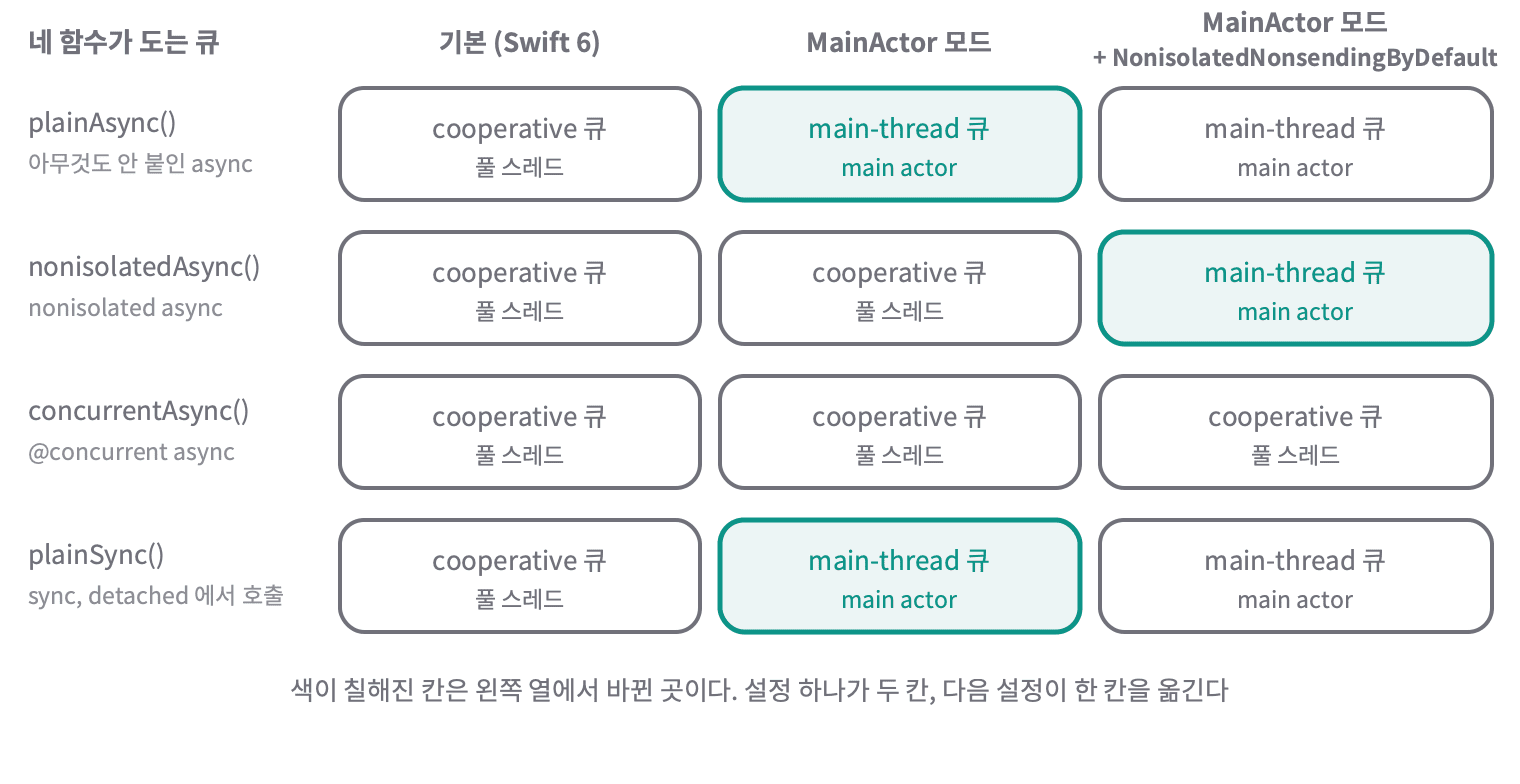
이 실험에서 일어난 일은 이렇다. 철자 없는 async 함수와 동기 함수가 cooperative 큐에서 main-thread 큐로 옮겨 갔다. 계산이 무거운 함수라면 main actor 를 막는다. 그래서 그런 함수에는 @concurrent 를 적는다. 이 제안은 @concurrent 를 새로 만들지 않았고, SE-0461 이 만들어 둔 것을 쓴다.
nonisolated 로 빠져나가기
main actor 에서 빼내고 싶은 코드는 nonisolated 로 빠져나온다. 타입 전체를 빼는 문법이 SE-0449 의 nonisolated struct 다.
NonisolatedType.swift
1
2
3
4
5
6
7
8
9
10
11
12
13
14
15
nonisolated struct Parser {
  var text: String

  func tokens() -> [Substring] {
    text.split(separator: " ")
  }

  struct Token {
    var value: Substring
  }
}

@concurrent func parse(_ text: String) async -> Int {
  Parser(text: text).tokens().count
}
Parser 는 문자열을 쪼개기만 하는 구조체이고 nonisolated 로 적었다. Token 은 그 안의 중첩 타입이고, parse(_:) 는 @concurrent 라서 main actor 밖에서 Parser 를 쓴다. 두 모드 모두 통과한다.
1
[exit 0]
1
[exit 0]
MainActor 모드의 AST 다.
1
2
3
4
5
6
7
8
9
10
11
12
13
14
15

nonisolated internal struct Parser {
  internal var text: String
  nonisolated internal func tokens() -> [Substring] {
    return self.text.split(separator: " ")
  }
  internal struct Token {
    internal var value: Substring
    internal init(value: Substring)
  }
  nonisolated internal init(text: String)
}
@concurrent internal func parse(_ text: String) async -> Int {
  return Parser(text: text).tokens().count
}
Parser 에 nonisolated 가 있고, 그 멤버 tokens() 와 init 도 nonisolated 다. 중첩 타입 Token 에는 속성이 없는데, 바깥이 nonisolated 타입이라서 기본값을 받지 않는다. 이 규칙은 추론 규칙의 그림에서 오른쪽 칸에 든 “nonisolated 타입 안의 중첩 타입” 이다.
nonisolated 를 빼면 어떻게 되는지도 같은 코드로 보았다. NonisolatedTypeMissing.swift 는 struct Parser 앞의 nonisolated 만 뺀 코드다.
1
2
3
4
5
6
7
8
NonisolatedTypeMissing.swift:14:22: error: main actor-isolated instance method 'tokens()' cannot be called from outside of the actor
12 |
13 | @concurrent func parse(_ text: String) async -> Int {
14 |   Parser(text: text).tokens().count
   |                      `- error: main actor-isolated instance method 'tokens()' cannot be called from outside of the actor
15 | }
16 |
[exit 1]
Parser.tokens() 가 @MainActor 로 추론되어서, @concurrent 인 parse(_:) 에서 부를 수 없다. 같은 코드가 기본 모드에서는 통과한다.
1
[exit 0]
이 한 쌍이 MainActor 모드에서 라이브러리 같은 코드를 쓸 때의 경계다. 동시성을 일부러 쓰는 코드는 nonisolated 와 @concurrent 를 직접 적는다. MainActor 모드는 그 표시를 줄여 주지 않고, 표시하지 않았을 때의 기본값만 바꾼다.
프로토콜과 conformance
처음에 본 conformance 오류가 MainActor 모드에서 왜 사라지는지는 프로토콜 isolation 에서 나왔다. 이번에는 같은 파일 안에서 nonisolated 프로토콜과 MainActor 모드의 타입을 조합한다.
ConformanceUse.swift
1
2
3
4
5
6
7
8
9
10
11
12
13
14
15
16
17
18
nonisolated protocol Describable {
  func describe() -> String
}

final class Counter: Describable {
  var count = 0
  func describe() -> String { "count = \(count)" }
}

nonisolated func show(_ d: some Describable) -> String { d.describe() }

func useOnMain() {
  print(show(Counter()))
}

nonisolated func useElsewhere(_ c: Counter) {
  print(show(c))
}
Describable 은 nonisolated 프로토콜이고, Counter 는 그것을 채택하는 클래스다. show(_:) 는 nonisolated 함수로 some Describable 을 받고, useOnMain() 은 철자 없는 함수, useElsewhere(_:) 는 nonisolated 함수다. 기본 모드에서는 모두 nonisolated 라서 통과한다.
1
[exit 0]
MainActor 모드에서는 Counter 가 @MainActor 이고 describe() 도 @MainActor 다. 프로토콜은 nonisolated 라고 직접 적었으니 그대로 두고, Counter 의 conformance 가 main actor 에 격리된 conformance 가 된다.
1
2
3
4
5
6
7
8
9
10
ConformanceUse.swift:17:9: error: main actor-isolated conformance of 'Counter' to 'Describable' cannot be used in nonisolated context [#IsolatedConformances]
15 |
16 | nonisolated func useElsewhere(_ c: Counter) {
17 |   print(show(c))
   |         `- error: main actor-isolated conformance of 'Counter' to 'Describable' cannot be used in nonisolated context [#IsolatedConformances]
18 | }
19 |

[#IsolatedConformances]: <https://docs.swift.org/compiler/documentation/diagnostics/isolated-conformances>
[exit 1]
오류가 나는 곳은 useElsewhere(_:) 의 show(c) 한 줄이다. useOnMain() 은 main actor 에서 conformance 를 써서 통과한다. 이 오류는 SE-0470 이 정한 isolated conformance 의 규칙이다. main actor 에 격리된 conformance 는 nonisolated 문맥에서 쓸 수 없다. MainActor 모드에서 nonisolated 프로토콜을 채택한 main actor 타입의 conformance 는 isolated conformance 로 추론된다. 오류 문구가 “main actor-isolated conformance” 라고 부르는 것이 그 conformance 다. 요구사항을 nonisolated 로 바꿔서 어디서든 쓰게 하는 대신, conformance 를 main actor 안에 가두는 쪽을 고른 것이다.
Codable 도 같은 모양이다. 표준 라이브러리의 Encodable 은 nonisolated 프로토콜이다.
CodableUse.swift
1
2
3
4
5
6
7
8
9
10
11
12
13
14
import Foundation

struct Point: Codable {
  var x = 0
  var y = 0
}

func encodeHere(_ p: Point) throws -> Data {
  try JSONEncoder().encode(p)
}

nonisolated func encodeElsewhere(_ p: Point) throws -> Data {
  try JSONEncoder().encode(p)
}
Point 는 Codable 구조체이고, encodeHere(_:) 는 철자 없는 함수, encodeElsewhere(_:) 는 nonisolated 함수다. 기본 모드는 통과한다.
1
[exit 0]
MainActor 모드에서는 encodeElsewhere(_:) 쪽이 막힌다.
1
2
3
4
5
6
7
8
9
10
CodableUse.swift:13:21: error: main actor-isolated conformance of 'Point' to 'Encodable' cannot be used in nonisolated context [#IsolatedConformances]
11 |
12 | nonisolated func encodeElsewhere(_ p: Point) throws -> Data {
13 |   try JSONEncoder().encode(p)
   |                     `- error: main actor-isolated conformance of 'Point' to 'Encodable' cannot be used in nonisolated context [#IsolatedConformances]
14 | }
15 |

[#IsolatedConformances]: <https://docs.swift.org/compiler/documentation/diagnostics/isolated-conformances>
[exit 1]
Point 의 Encodable conformance 가 main actor 에 격리되어서 nonisolated 함수에서 JSONEncoder().encode(p) 를 부를 수 없다. encodeHere(_:) 는 통과한다. 고치는 길은 Point 를 nonisolated struct 로 만드는 것이다. 이 모양의 오류가 라이브러리 쪽에서 어떻게 보였는지는 스레드 절에서 다시 나온다.
Sendable 을 물려받는 프로토콜
수정안이 더한 규칙이 이 절이다. 처음 제안은 “isolation 을 적지 않은 선언에 @MainActor” 였다. 그런데 Sendable 을 상속한 프로토콜을 채택한 타입에 @MainActor 가 붙으면, 그 타입은 Sendable 프로토콜의 요구사항을 main actor 로 격리된 채로 구현해야 한다. 수정안은 이 경우 기본값을 적용하지 않게 했다. 수정안 pitch 에서 Doug Gregor 는 Sendable 프로토콜 채택, 기본 isolation, nonisolated 멤버, 합성된 conformance 네 가지를 문제로 꼽았다(수정안 pitch #1, Douglas_Gregor). 이 규칙은 초안에서는 Sendable 상속 여부로 정하려다가, 같은 pitch 의 #6 에서 SendableMetatype 상속 여부로 바뀐다(수정안 pitch #6, Douglas_Gregor). Sendable 은 SendableMetatype 을 상속하는 프로토콜이라서 Sendable 을 상속한 프로토콜은 모두 이 규칙에 든다.
SendableProto.swift
1
2
3
4
5
6
7
nonisolated protocol Q: Sendable {
  func f()
}

final class D: Q {
  func f() {}
}
Q 는 Sendable 을 상속하는 nonisolated 프로토콜이고, D 는 그것을 채택한 final 클래스다. 두 모드 모두 통과한다.
1
[exit 0]
1
[exit 0]
MainActor 모드의 AST 다.
1
2
3
4
5
6
7
8
9
10
11
12
13
14

nonisolated internal protocol Q : Sendable {
  nonisolated func f()
}

final internal class D : Q {
  final internal func f() {
  }
  @objc deinit {
  }
  internal init() {

  }
}
D 에도 f() 에도 @MainActor 가 붙지 않았다. Q 가 Sendable 을 상속하고 D 가 Q 를 직접 채택해서, D 는 기본값을 받지 않는다. Q 에서 nonisolated 를 빼도 규칙이 같을까. 프로토콜의 nonisolated 를 뺀 파일로 확인했다.
SendableProtoPlain.swift
1
2
3
4
5
6
7
protocol Q: Sendable {
  func f()
}

final class D: Q {
  func f() {}
}
1
[exit 0]
오류는 없다. AST 는 이렇다.
1
2
3
4
5
6
7
8
9
10
11
12
13
14

@MainActor internal protocol Q : Sendable {
  @MainActor func f()
}

@MainActor final internal class D : Q {
  @MainActor final internal func f() {
  }
  @objc deinit {
  }
  nonisolated internal init() {

  }
}
nonisolated 를 뺀 프로토콜은 @MainActor 프로토콜이 되고, D 도 @MainActor 가 된다. 직접 채택한 타입이 기본값을 받지 않는 경우는 프로토콜을 nonisolated 로 적어서 main actor 에 묶이지 않게 한 쪽이다. D 가 final 이 아니면 Sendable 프로토콜을 채택할 수 없다는 오류가 규칙과 상관없이 따로 난다. SendableProtoNonFinal.swift 는 D 에서 final 만 뺀 코드다.
SendableProtoNonFinal.swift
1
2
3
4
5
6
7
nonisolated protocol Q: Sendable {
  func f()
}

class D: Q {
  func f() {}
}
1
2
3
4
5
6
7
8
SendableProtoNonFinal.swift:5:7: error: non-final class 'D' cannot conform to the 'Sendable' protocol
3 | }
4 |
5 | class D: Q {
  |       `- error: non-final class 'D' cannot conform to the 'Sendable' protocol
6 |   func f() {}
7 | }
[exit 1]
1
2
3
4
5
6
7
8
SendableProtoNonFinal.swift:5:7: error: non-final class 'D' cannot conform to the 'Sendable' protocol
3 | }
4 |
5 | class D: Q {
  |       `- error: non-final class 'D' cannot conform to the 'Sendable' protocol
6 |   func f() {}
7 | }
[exit 1]
두 모드 모두 SendableProtoNonFinal.swift:5:7 에 같은 오류가 난다.
CodingKeys 에 @MainActor 가 붙지 않는 이유가 이 규칙이다. 표준 라이브러리의 CodingKey 는 Sendable 을 상속하고, Sendable 은 SendableMetatype 을 상속한다. enum CodingKeys: CodingKey 는 본 정의에서 이 프로토콜을 직접 채택하니 기본값을 받지 않고, 그 바깥의 struct S 는 @MainActor 로 남는다. 제안서는 Alternatives 의 SendableMetatype 항목에서 CodingKeys 를 이 문제의 예로 들고, 같은 문제가 있는 것으로 Transferable 프로토콜과 @Model 매크로가 쓰는 key path 를 덧붙인다. 손으로 쓴 CodingKeys 가 아니라 Codable 이 합성하는 CodingKeys 도 같은지 CodingKeysSynth.swift 로 보았다.
CodingKeysSynth.swift
1
2
3
struct S: Codable {
  var a: Int
}
두 모드 모두 컴파일된다.
1
[exit 0]
1
[exit 0]
MainActor 모드의 AST 에서 S, 프로퍼티 a, CodingKeys 의 선언 줄만 남겼다.
1
2
3
@MainActor internal struct S : Codable {
  @MainActor internal var a: Int
  private enum CodingKeys : CodingKey {
합성된 CodingKeys 도 속성이 없고 S 와 a 는 @MainActor 다.
이 규칙이 “타입의 primary definition” 에서 직접 채택한 경우에만 적용된다는 점이 같은 파일 extension 에서 갈린다. SendableProtoExt.swift 는 같은 D 를 extension 으로 채택하게 한 코드다.
SendableProtoExt.swift
1
2
3
4
5
6
7
8
9
nonisolated protocol Q: Sendable {
  func f()
}

final class D {}

extension D: Q {
  func f() {}
}
기본 모드에서는 통과한다.
1
[exit 0]
MainActor 모드에서는 D 의 본 정의에 채택이 없으므로 D 는 @MainActor 가 되고, extension 의 conformance 가 막힌다.
1
2
3
4
5
6
7
8
9
10
11
12
13
14
15
SendableProtoExt.swift:7:14: error: conformance of 'D' to protocol 'Q' crosses into main actor-isolated code and can cause data races [#ConformanceIsolation]
 5 | final class D {}
 6 |
 7 | extension D: Q {
   |              |- error: conformance of 'D' to protocol 'Q' crosses into main actor-isolated code and can cause data races [#ConformanceIsolation]
   |              |- note: isolate this conformance to the main actor with '@MainActor'
   |              `- note: turn data races into runtime errors with '@preconcurrency'
 8 |   func f() {}
   |        |- note: main actor-isolated instance method 'f()' cannot satisfy nonisolated requirement
   |        `- note: mark instance method 'f()' 'nonisolated'
 9 | }
10 |

[#ConformanceIsolation]: <https://docs.swift.org/compiler/documentation/diagnostics/conformance-isolation>
[exit 1]
오류는 “D 의 Q conformance 가 main actor 격리 코드로 넘어간다” 이고, f() 가 main actor 에 격리되어 nonisolated 요구사항을 만족시킬 수 없다는 노트가 따른다. 같은 파일의 extension 으로 채택해도 풀리지 않는다는 뜻이다. 수정안 수락 공지가 남은 논의로 꼽은 것이 이 지점이다. 수정안 리뷰에서 Douglas_Gregor 와 hborla 는 이 판단이 타입의 primary declaration 만 본다고 설명한다(수정안 리뷰 #8, #9). 스레드 절에서 다시 본다.
override 와 SDK 클래스
마지막 질문은 override 다. 슈퍼클래스가 nonisolated 이면 서브클래스의 override 도 nonisolated 여야 한다. 먼저 SDK 의 main actor API 를 부르는 쪽부터 본다.
SDKCall.swift
1
2
3
4
5
6
7
8
9
@MainActor
final class Screen {
  var title = ""
  static let shared = Screen()
}

func rename() {
  Screen.shared.title = "Home"
}
Screen 은 @MainActor 클래스로, SDK 가 제공하는 UI 타입을 흉내 낸 것이다. rename() 은 철자 없는 함수다. 기본 모드의 진단이다.
1
2
3
4
5
6
7
8
9
10
11
12
13
14
15
16
17
18
19
20
21
22
23
24
25
26
27
28
29
SDKCall.swift:8:17: error: main actor-isolated property 'title' can not be mutated from a nonisolated context
 1 | @MainActor
 2 | final class Screen {
 3 |   var title = ""
   |       `- note: mutation of this property is only permitted within the actor
 4 |   static let shared = Screen()
 5 | }
 6 |
 7 | func rename() {
   |      `- note: add '@MainActor' to make global function 'rename()' part of global actor 'MainActor'
 8 |   Screen.shared.title = "Home"
   |                 `- error: main actor-isolated property 'title' can not be mutated from a nonisolated context
 9 | }
10 |

SDKCall.swift:8:10: error: main actor-isolated static property 'shared' can not be mutated from a nonisolated context
 2 | final class Screen {
 3 |   var title = ""
 4 |   static let shared = Screen()
   |              `- note: mutation of this static property is only permitted within the actor
 5 | }
 6 |
 7 | func rename() {
   |      `- note: add '@MainActor' to make global function 'rename()' part of global actor 'MainActor'
 8 |   Screen.shared.title = "Home"
   |          `- error: main actor-isolated static property 'shared' can not be mutated from a nonisolated context
 9 | }
10 |
[exit 1]
rename() 이 nonisolated 라서 @MainActor 인 Screen.shared.title 을 고칠 수 없다. 앞의 Motivation 과 같은 이유다. MainActor 모드에서는 rename() 이 @MainActor 라서 통과한다.
1
[exit 0]
반대 방향 오류가 override 에서 난다. Foundation 의 NSObject 는 nonisolated 이고, 그 서브클래스가 description 을 override 한다.
OverrideSDK.swift
1
2
3
4
5
6
7
8
import Foundation

final class Item: NSObject {
  var title = "item"
  override var description: String {
    "Item(\(title))"
  }
}
기본 모드는 통과한다.
1
[exit 0]
MainActor 모드에서는 Item 이 @MainActor 가 되고, 그 안의 description 도 @MainActor 가 된다. NSObject.description 은 nonisolated 라서 override 의 isolation 이 달라진다. 부모 선언이나 프로토콜에서 물려받은 isolation 이 기본값보다 앞서는 것은 그것이 global actor 일 때뿐이다. 부모 멤버가 nonisolated 이면 물려받을 global actor 가 없어서 기본값 @MainActor 가 그대로 붙고, 그래서 override 와 부모의 isolation 이 어긋난다.
1
2
3
4
5
6
7
8
9
10
11
12
13
14
15
16
17
18
19
20
21
22
23
24
25
26
27
28
29
30
31
32
OverrideSDK.swift:5:36: error: main actor-isolated getter for property 'description' has different actor isolation from nonisolated overridden declaration
3 | final class Item: NSObject {
4 |   var title = "item"
5 |   override var description: String {
  |                                    `- error: main actor-isolated getter for property 'description' has different actor isolation from nonisolated overridden declaration
6 |     "Item(\(title))"
7 |   }

/Applications/Xcode.app/Contents/Developer/Platforms/MacOSX.platform/Developer/SDKs/MacOSX27.0.sdk/usr/include/objc/NSObject.h:43:38: note: overridden declaration is here
 41 | - (struct _NSZone *)zone OBJC_ARC_UNAVAILABLE;
 42 |
 43 | @property (readonly, copy) NSString *description;
    |                                      `- note: overridden declaration is here
 44 | @optional
 45 | @property (readonly, copy) NSString *debugDescription;

OverrideSDK.swift:5:16: error: main actor-isolated property 'description' has different actor isolation from nonisolated overridden declaration
3 | final class Item: NSObject {
4 |   var title = "item"
5 |   override var description: String {
  |                `- error: main actor-isolated property 'description' has different actor isolation from nonisolated overridden declaration
6 |     "Item(\(title))"
7 |   }

/Applications/Xcode.app/Contents/Developer/Platforms/MacOSX.platform/Developer/SDKs/MacOSX27.0.sdk/usr/include/objc/NSObject.h:43:38: note: overridden declaration is here
 41 | - (struct _NSZone *)zone OBJC_ARC_UNAVAILABLE;
 42 |
 43 | @property (readonly, copy) NSString *description;
    |                                      `- note: overridden declaration is here
 44 | @optional
 45 | @property (readonly, copy) NSString *debugDescription;
[exit 1]
오류가 둘이다. getter 의 isolation 과 프로퍼티의 isolation 이 각각 다르다고 한다. 노트는 SDK 의 NSObject.h 를 가리키며 “overridden declaration is here” 라고 한다. 고치는 길은 override 쪽을 nonisolated 로 만드는 것이다. description 이 title 을 읽으므로 title 도 어디서든 읽을 수 있어야 한다. OverrideSDKFix.swift 는 title 을 nonisolated let 으로 둔 코드다.
OverrideSDKFix.swift
1
2
3
4
5
6
7
8
import Foundation

final class Item: NSObject {
  nonisolated let title = "item"
  nonisolated override var description: String {
    "Item(\(title))"
  }
}
1
[exit 0]
1
[exit 0]
두 모드 모두 통과한다. 여기서 title 에 nonisolated 가 꼭 필요한지 보려고 OverrideSDKLet.swift 는 let title 만 남기고 nonisolated 를 뺐다. description 의 nonisolated override 는 그대로다.
OverrideSDKLet.swift
1
2
3
4
5
6
7
8
import Foundation

final class Item: NSObject {
  let title = "item"
  nonisolated override var description: String {
    "Item(\(title))"
  }
}
1
[exit 0]
1
[exit 0]
두 모드 모두 통과한다. 요점은 let 이다. 상수라서 어느 actor 에서 읽어도 안전하다. 이 오류가 @MainActor 를 직접 붙인 클래스에서도 나는지도 같이 보았다.
OverrideSDKMain.swift 는 Item 에 @MainActor 를 직접 붙인 코드다.
1
2
3
4
5
6
7
8
9
10
11
OverrideSDKMain.swift:7:13: warning: main actor-isolated property 'title' can not be referenced from a nonisolated context
 3 | @MainActor
 4 | final class Item: NSObject {
 5 |   var title = "item"
   |       `- note: property declared here
 6 |   override var description: String {
 7 |     "Item(\(title))"
   |             `- warning: main actor-isolated property 'title' can not be referenced from a nonisolated context
 8 |   }
 9 | }
[exit 0]
기본 Swift 6 모드에서는 description 의 override 가 오류 없이 지나가고, title 을 읽는 곳에서 경고 하나만 난다. description 이 슈퍼클래스를 따라 nonisolated 로 읽히고 title 은 @MainActor 클래스의 프로퍼티이기 때문이다. 같은 코드를 MainActor 모드로 컴파일하면 위와 같은 두 오류가 난다.
1
2
3
4
5
6
7
8
9
10
11
12
13
14
15
16
17
18
19
20
21
22
23
24
25
26
27
28
29
30
31
32
OverrideSDKMain.swift:6:36: error: main actor-isolated getter for property 'description' has different actor isolation from nonisolated overridden declaration
 4 | final class Item: NSObject {
 5 |   var title = "item"
 6 |   override var description: String {
   |                                    `- error: main actor-isolated getter for property 'description' has different actor isolation from nonisolated overridden declaration
 7 |     "Item(\(title))"
 8 |   }

/Applications/Xcode.app/Contents/Developer/Platforms/MacOSX.platform/Developer/SDKs/MacOSX27.0.sdk/usr/include/objc/NSObject.h:43:38: note: overridden declaration is here
 41 | - (struct _NSZone *)zone OBJC_ARC_UNAVAILABLE;
 42 |
 43 | @property (readonly, copy) NSString *description;
    |                                      `- note: overridden declaration is here
 44 | @optional
 45 | @property (readonly, copy) NSString *debugDescription;

OverrideSDKMain.swift:6:16: error: main actor-isolated property 'description' has different actor isolation from nonisolated overridden declaration
 4 | final class Item: NSObject {
 5 |   var title = "item"
 6 |   override var description: String {
   |                `- error: main actor-isolated property 'description' has different actor isolation from nonisolated overridden declaration
 7 |     "Item(\(title))"
 8 |   }

/Applications/Xcode.app/Contents/Developer/Platforms/MacOSX.platform/Developer/SDKs/MacOSX27.0.sdk/usr/include/objc/NSObject.h:43:38: note: overridden declaration is here
 41 | - (struct _NSZone *)zone OBJC_ARC_UNAVAILABLE;
 42 |
 43 | @property (readonly, copy) NSString *description;
    |                                      `- note: overridden declaration is here
 44 | @optional
 45 | @property (readonly, copy) NSString *debugDescription;
[exit 1]
@MainActor 를 직접 붙인 클래스에서도 MainActor 모드가 켜져 있으면 override 가 오류다. 같은 @MainActor 클래스인데 모드에 따라 결과가 다르다는 것이 이 실험의 요점이다.
같은 모듈 안의 클래스 상속에서도 오류가 난다. Override.swift 는 아무것도 안 붙인 Base 의 메서드를 @MainActor 서브클래스 Child 가 override 한다.
Override.swift
1
2
3
4
5
6
7
8
9
10
11
class Base {
  func update() {}
}

@MainActor
final class Child: Base {
  var value = 0
  override func update() {
    value += 1
  }
}
기본 Swift 6 모드의 진단이다.
1
2
3
4
5
6
7
8
9
10
11
Override.swift:9:5: error: main actor-isolated property 'value' can not be mutated from a nonisolated context
 5 | @MainActor
 6 | final class Child: Base {
 7 |   var value = 0
   |       `- note: mutation of this property is only permitted within the actor
 8 |   override func update() {
 9 |     value += 1
   |     `- error: main actor-isolated property 'value' can not be mutated from a nonisolated context
10 |   }
11 | }
[exit 1]
오류는 value += 1 에 난다. update() 가 슈퍼클래스를 따라 nonisolated 로 읽히는데 value 는 @MainActor 클래스의 프로퍼티라서 고칠 수 없다. MainActor 모드에서는 오류가 다른 곳에 난다.
1
2
3
4
5
6
7
8
9
10
11
12
Override.swift:6:25: error: main actor-isolated initializer 'init()' has different actor isolation from nonisolated overridden declaration
 1 | class Base {
   |       `- note: overridden declaration is here
 2 |   func update() {}
 3 | }
 4 |
 5 | @MainActor
 6 | final class Child: Base {
   |                         `- error: main actor-isolated initializer 'init()' has different actor isolation from nonisolated overridden declaration
 7 |   var value = 0
 8 |   override func update() {
[exit 1]
이번 오류는 Child 의 init() 에 난다. 쓰지 않은 init 이 @MainActor 가 되어서 nonisolated 인 Base.init() 과 isolation 이 다르다는 것이다. @MainActor 를 손으로 붙이지 않은 코드에서도 같은지 보았다. OverrideDefault.swift 는 Child 의 @MainActor 만 뺀 코드다.
1
[exit 0]
1
2
3
4
5
6
7
8
9
10
11
OverrideDefault.swift:5:25: error: main actor-isolated initializer 'init()' has different actor isolation from nonisolated overridden declaration
 1 | class Base {
   |       `- note: overridden declaration is here
 2 |   func update() {}
 3 | }
 4 |
 5 | final class Child: Base {
   |                         `- error: main actor-isolated initializer 'init()' has different actor isolation from nonisolated overridden declaration
 6 |   var value = 0
 7 |   override func update() {
[exit 1]
기본 모드에서는 통과하고 MainActor 모드에서만 init() 오류가 난다. 서브클래스가 직접 init 을 쓰면 어떨까. OverrideInit.swift 는 override init() { super.init() } 를 더한 코드다.
1
[exit 0]
1
2
3
4
5
6
7
8
9
10
11
12
13
OverrideInit.swift:7:12: error: main actor-isolated initializer 'init()' has different actor isolation from nonisolated overridden declaration
 1 | class Base {
   |       `- note: overridden declaration is here
 2 |   func update() {}
 3 | }
   :
 5 | final class Child: Base {
 6 |   var value = 0
 7 |   override init() { super.init() }
   |            `- error: main actor-isolated initializer 'init()' has different actor isolation from nonisolated overridden declaration
 8 |   override func update() {
 9 |     value += 1
[exit 1]
직접 쓴 override init() 에도 @MainActor 가 붙어서 같은 오류가 난다. 오류가 나는 자리가 쓰지 않은 init 에서 직접 쓴 init 으로 옮겨 갔을 뿐이다. MainActor 모드에서는 Base 도 @MainActor 인데, 부모가 없는 Base 의 쓰지 않은 init() 만 앞에서 본 규칙대로 nonisolated 로 남는다. 서브클래스 Child 의 init() 은 합성하든 직접 쓰든 @MainActor 라서, 부모의 nonisolated init() 과 isolation 이 맞지 않는다. override init() 앞에 nonisolated 를 적으면 풀린다.
OverrideInitFix.swift
1
2
3
4
5
6
7
8
9
10
11
class Base {
  func update() {}
}

final class Child: Base {
  var value = 0
  nonisolated override init() { super.init() }
  override func update() {
    value += 1
  }
}
1
[exit 0]
AST 로 보면 Base 와 Base.update(), Child 와 Child.update() 는 모두 @MainActor 이고, 두 init() 만 nonisolated 다. 같은 모듈의 클래스끼리는 update() 의 isolation 이 서로 맞는다. 맞지 않는 곳은 쓰지 않은 init 과 SDK 의 nonisolated 선언이다.
스레드에서 오간 이야기
이 제안의 포럼 스레드는 여섯 개다. pitch 24 개 글, 리뷰 30 개 글(#1 은 리뷰 공지, #29 는 수락 공지 링크, #30 은 빈 글), 수락 공지, 수정안 pitch 15 개 글, 수정안 리뷰, 수정안 수락 공지다. 오간 이야기를 주제별로 묶는다. 인용 표기는 앞 글들처럼 (스레드 #번호, 글쓴이) 로 적는다.
언어가 둘로 갈라지는가
가장 많이 나온 걱정은 이 모드가 언어를 둘로 가르지 않느냐는 것이다. 소스 파일만 보고는 코드가 맞는지 판단할 수 없게 된다는 지적이 여러 번 나온다. pitch 에서 xwu 가 소스에 표시가 없는 dialect 라는 점을 짚었다(pitch #2, xwu). amayers 는 명시적인 표시를 원했다(pitch #3, amayers). 리뷰에서 KeithBauerANZ 는 이 설정이 @MainActor 를 적는 수고를 줄이는 정도의 값어치인데 코드의 정답이 방언에 따라 달라지는 비용을 지운다고 보았고, 전역 변수까지 쓸 수 있게 만드는 것에 반대했다(리뷰 #2, KeithBauerANZ). 같은 글에서 켜는 쪽이 opt-in 이라 방향은 맞다고도 한다. ktoso 는 방언이 생기는 것이 아쉽지만 기본값을 조정하는 정도라고 보았고, 이 설정은 opt-in 이라서 swift package init 으로 만든 패키지에는 꺼 두는 것이 맞으며, 장난감 앱과 앱 개발자에게는 쓸모가 보인다고 했다(리뷰 #3, ktoso). 8675309 는 이 방언이 나중에 후회가 될 큰 변화라고 보았고, 넣을 거라면 Swift 7 에서 기본값도 바꾼다고 공개 약속해야 한다고 했다(리뷰 #7, 8675309). 나중에 코드 리뷰가 평문 diff 로 이뤄지는 점을 위험 분석이 빠뜨렸다고도 한다(리뷰 #18, 8675309). EngOmarElsayed 는 @MainActor 는 UI 를 위한 특수한 경우이지 기본값이 아니어야 한다고 했다(리뷰 #23, EngOmarElsayed).
hborla 는 같은 질문에 이 위험이 Vision 문서의 “language dialect” 항목에서 다뤄진다고 답했고, 제안서의 Alternatives 에도 upcoming feature 로 하는 안이 실려 있다고 했다(리뷰 #17, hborla). Douglas_Gregor 의 답이 가장 길다(리뷰 #21, Douglas_Gregor). 그는 이 제안을 지지한다고 먼저 밝히고, Swift 6 의 progressive disclosure 곡선을 매끄럽게 해야 하며 동시성은 그 곡선에서 “나중” 에 나와야 한다고 했다. 대부분의 코드는 자기가 어느 isolation 에서 도는지 신경 쓰지 않는데, 신경 쓰는 코드가 조금만 있어도 그 영향이 코드베이스 전체로 퍼진다는 것이 그가 보는 어려움이다. UI 스택과 전역 변수가 main-actor 의 씨앗을 코드베이스에 심고, 함수가 특정 actor 에서 돌아야 하는지는 인터페이스의 일부라서 그 확산을 멈출 방법이 없다고 한다. 모드를 영영 두 개로 두는 일과 그 모드에서 나오는 길이 걱정이라는 점도 인정하면서, 단일 스레드에서 data-race 없는 사용으로 가는 매끄러운 길이 목표라는 입장이다. 같은 글에서 SE-0461 이 언어가 요청 없이 동시성을 끌어들이던 유일한 곳을 고친다고 짚었다.
수락 공지는 리뷰 반응이 대체로 긍정적이었고, “mode” 를 더하는 것이 정말 필요한지에 대한 우려가 있었다고 적는다. Language Steering Group 도 비슷한 느낌이었지만 Swift 6 의 progressive disclosure 곡선을 매끄럽게 하려면 이 모서리를 다듬어야 한다고 판단했고, Doug 의 글이 그 입장을 잘 대변한다고 했다(수락 #1, scanon).
누가 켜고 싶어 하는가
켜고 싶다는 쪽의 목소리도 리뷰에 여럿 있다. Airbnb 의 cal 은 큰 앱에서 Swift Concurrency 와 Swift 6 모드를 받아들이는 데 크게 도움이 된다고 했다. 지금 feature 계층에서 하는 일이 “전부 @MainActor 로” 에 가까운데 번거롭고 시끄럽다는 이유다(리뷰 #5, cal). GetYourGuide 의 marinofelipe 는 feature, UI, presentation 모듈에 켜겠다고 했다(리뷰 #20, marinofelipe). Swift 강의를 하는 svanimpe 는 이런 기능이 “absolutely required” 라고 했다. progressive disclosure 를 지키려면 지금 Swift 6 는 가르치기 어려워서, 이 기능이 나올 때까지 Swift 5 모드에 머물겠다는 것이다(리뷰 #9, svanimpe). pitch 단계에서 davbeck 은 새 Xcode 앱 타깃에는 기본으로 켜져야 한다고 했다(pitch #18, davbeck). 지금 Xcode 템플릿이 그렇게 나온다는 것은 앞에서 본 SWIFT_DEFAULT_ACTOR_ISOLATION 설정에서 이미 보였다.
반대쪽에서는 이 모드가 필요한 코드가 무엇이냐가 계속 물렸다. crontab 은 낡은 OOP 코드에는 좋은 기본값이지만 새로 쓰는 SwiftUI 앱은 필요 없을 것이고, 구조적 동시성을 우회하게 부추기며, 이 옵션을 권하는 StackOverflow 답이 쏟아질 것이라고 걱정했다(리뷰 #8, crontab). 예제를 달라는 요청과 그 답은 아래 전역 변수와 최상위 코드 절에서 이어진다.
모듈 단위인가 파일 단위인가
적용 범위는 pitch 와 리뷰 모두에서 나왔다. KeithBauerANZ 는 파일 단위 설정이 더 낫고 Xcode 파일 템플릿에 넣을 수 있다고 했다(리뷰 #4, KeithBauerANZ). ktoso 는 파일 단위 CompilerSettings pitch 가 이 제안과 합쳐질 수 있다고 했다(리뷰 #3, ktoso). jlukas 는 최상위 코드와 @main 이 있는 파일에서만 켜고 싶다고 했다(리뷰 #19, jlukas). 앞에서 본 것처럼 제안서는 파일 단위를 Future direction 으로 남겼다.
범위를 줄이자는 제안도 있었다. KeithBauerANZ 는 클래스 타입과 전역 변수에만 적용하거나, 공개 선언이 아닌 것에만 적용하자고 했다(리뷰 #2, KeithBauerANZ). hborla 는 둘 다 받지 않았다. 클래스와 전역 변수에만 적용하면 @MainActor 가 전이되는 성질 때문에 틀어지고, 비공개 선언에만 적용하는 안은 한 실행 파일 프로젝트의 일부인 라이브러리를 생각하면 곤란하며 외부 라이브러리의 공개 API 는 명시적이어야 한다는 것이다(리뷰 #16, hborla). 같은 글에서 목표를 progressive disclosure(isolation 을 언제 마주치느냐)와 단일 스레드 코드의 false positive 감소로 정리하고, 안전하게 쓰는 가변 전역 변수는 문제없어서 없애는 것은 불가능한 안이라고 했다.
pitch 에서 allevato 는 새 설정 값 대신 DefaultActorIsolation 같은 typealias 를 소스에 쓰는 방식을 제안했다(pitch #4, #7, allevato). hborla 는 철자가 틀려도 유효한 코드가 되고, nonisolated 를 나타낼 방법을 따로 만들어야 하고, 타입 검사의 순환 문제가 있다고 답했다(pitch #8, hborla). jakepetroules 는 manifest API 로 enum 을 원했는데(pitch #21 와 #23, jakepetroules), hborla 는 값이 MainActor.self 와 nil 뿐이고 커스텀 global actor 는 대안으로 실려 있다고 답했다(pitch #22, hborla). 이 가운데 enum 안은 제안서의 Alternatives 에 실렸고 typealias 안은 실리지 않았다. 커스텀 global actor 항목은 pitch #8 보다 앞서 있던 항목이다.
deinit 과 마이그레이션
리뷰 초반에 Nickolas_Pohilets 가 deinit 이 isolated 가 되느냐고 물었다(리뷰 #6, Nickolas_Pohilets). hborla 는 그렇다고 답했다(리뷰 #17, hborla). 지금은 쓰지 않은 deinit 만 main actor 에서 돌고, 직접 쓴 deinit 은 isolated 를 적어야 한다. 앞의 init 과 deinit 절에서 본 그대로다.
마이그레이션 방향도 한 번 정리되었다. hborla 는 두 방향이 모두 가능하다고 했다. nonisolated 에서 MainActor 로 가는 쪽은 isolation 이 정해지지 않은 선언에 nonisolated 를 끼워 넣는 작업이고, MainActor 에서 nonisolated 로 가는 쪽은 더 까다로워서 모듈 전체의 분석이 필요하다는 것이다(리뷰 #22, hborla).
전역 변수와 최상위 코드
예제를 달라는 crontab 의 요청에 svanimpe 는 전역과 static 변수를 들었고, 초반 예제는 main.swift 하나로 시작한다고 답했다(리뷰 #10 와 #11, crontab 과 svanimpe). crontab 은 전역 변수가 있으면 최상위 코드가 따라오는데, 최상위 코드는 경험이 쌓이기 전에는 쓰지 말라고 가르치면 되지 않느냐고 물었다. Swift 가 이제 스크립트 언어도 OOP 우선 언어도 아니니 낡은 개념을 가르칠 이유가 없다는 것이다(리뷰 #12, crontab). Nobody1707 은 최상위 코드가 애초에 가르치기 쉽게 하려고 있는 것인데, 첫 수업에서 쓰지 말라고 가르치면 후퇴라고 했다(리뷰 #13, Nobody1707). crontab 은 Xcode Playground 에서는 최상위 코드와 변수가 문제없으니 기본 개념은 거기서 익히면 되고, 실제 앱을 만드는 순간 동시성의 영역에 들어선다는 것을 이해하면 된다고 답했다(리뷰 #14, crontab). 이 논쟁은 이 글의 첫 실험(전역 변수 두 개)이 왜 제안서의 첫 예이기도 한지를 보여 준다.
수정안에서 나온 라이브러리 작성자의 목소리
수락 뒤에 수정안이 따로 올라왔다. Doug 가 SE-0470 의 isolated conformance 추론을 다른 기능과 같이 써 보다가 규칙 몇 곳을 고쳐야 한다고 본 것이다(수정안 pitch #1, Douglas_Gregor). Andropov 는 여러 글에서 소스에 명시적인 표시가 남기를 원했고(수정안 pitch #2, #4, #10, #13, Andropov), Nickolas_Pohilets 는 읽기 어려워진다며 nonisolated 를 소스에서 보고 싶다고 했다(수정안 pitch #5, Nickolas_Pohilets). Doug 는 이 추론을 타입 추론에 빗댔고(수정안 pitch #3, Douglas_Gregor), Swift 6.2 베타가 나온 뒤로 “되어야 하는데 안 되는” main-actor 기본 코드에 대한 피드백이 많이 들어왔다고 했다. 라이브러리가 쓰는 프로토콜이 main-actor 기본값을 막을 수 있어야 한다는 이야기가 swiftlang/swift 의 이슈 #82249 에 정리되어 있다고 했다(수정안 pitch #6, Douglas_Gregor). 그 글에서 조건이 Sendable 상속에서 SendableMetatype 상속으로 바뀌고, 실험 flag 뒤에 컴파일러 구현이 올라갔다. 그는 CodingKeys 같은 타입에 nonisolated 를 적으라고 요구하면 동시성이 학습 곡선의 너무 이른 곳으로 당겨진다고 했다(수정안 pitch #14, Douglas_Gregor). 같은 글에서 bjhomer 가 든 접근 제어 비유에는, 접근 제어는 개발자가 타입에 public 을 적어서 그 모델을 이미 직접 택한 뒤에만 추가 표기를 요구한다고 반박했다.
수정안 리뷰는 2025-07-09 부터 07-15 까지 신속 리뷰로 진행되었다(수정안 리뷰 #1, scanon). gwendal.roue 가 라이브러리 작성자 입장에서 가장 많이 글을 남겼다(수정안 리뷰 #4, #5, #7, #10, #15, #16, #17). 같은 파일 extension 으로 채택한 경우, 중첩 타입, “identity” 개념, 매크로가 주제다. 그가 원한 것은 같은 파일에 선언한 conformance 도 기본값을 막는 규칙이다(수정안 리뷰 #7, gwendal.roue). Doug 는 가장 가까운 선례가 프로토콜에서 @MainActor 를 추론하는 규칙인데 그 규칙이 같은 파일 extension 을 보지 않는다고 답했고(수정안 리뷰 #8, Douglas_Gregor), hborla 는 프로토콜의 isolation 이 타입에 영향을 주는 것이 본 선언에 conformance 가 있을 때뿐인 일관된 규칙이 더 이해하기 쉽다고 했다(수정안 리뷰 #9, hborla). stephencelis 와 mbrandonw 는 매크로가 더한 conformance 가 추론에 반영되지 않는 점을 짚었다. stephencelis 는 extension 매크로가 타입에 직접 붙어 있으니 타입의 identity 로 볼 수 있다고 했고, 지금은 사용자가 nonisolated 를 직접 적어야 하는데 그 오류가 매크로 확장 안에 숨어 난해하다고 했다(수정안 리뷰 #13, stephencelis). mbrandonw 는 매크로에 defaultIsolationIsMainActor: true 같은 인자를 더하는 방식이 퍼지고 있다고 소개하면서, 그 인자를 모든 매크로가 더해야 하고 사용자가 인자를 줘야 한다는 것도 알기 어렵다고 지적했다(수정안 리뷰 #14, mbrandonw). 나중에 mbrandonw 는 Sendable 요구를 줄여서 두 모드를 모두 지원할 수 있게 되었고, isolated conformance 덕에 개선도 있었다고 덧붙였다(수정안 리뷰 #18, mbrandonw).
수락 공지는 수정안이 SE-0466 의 거친 모서리를 다듬는다는 데 폭넓은 동의가 있었다고 적는다. 같은 파일 extension 에 대한 논의가 남았고, conformance 를 extension 에 두려는 사람들의 걱정과 매크로와의 상호작용을 이해하지만 수정안의 동작이 사용성에서 의미 있는 개선이라고 판단했다고 한다(수정안 수락 #1, scanon).
그 뒤의 논의는 수락 스레드에 이어서 달렸다. gwendal.roue 는 2025-10-03 과 10-06 에 GRDB 와 sqlite-data 의 이슈를 연결하면서, Xcode 26 에서 main actor 기본값으로 나오는 새 프로젝트가 라이브러리 사용자에게 컴파일러 오류를 쏟아낸다고 적었다(수정안 수락 #2, #3, gwendal.roue). mbrandonw 는 두 가지를 구분했다. 이 sqlite-data 이슈는 최근 변경이 기본 main actor isolation 을 우연히 깨뜨린 것이고, 앞서 겪은 문제 대부분은 라이브러리의 프로토콜에 Sendable 을 덜 굳히는 쪽으로 고쳤다는 것이다(수정안 수락 #4, mbrandonw). 같은 글에서 SPM 이 .defaultIsolation(MainActor.self) 를 테스트에서 존중하지 않는 것처럼 보여서 이 모드의 자동 테스트가 어렵다는 점도 지적했다. 8675309 는 프로토콜 정의 자체가 actor 요구사항을 가지는 것에 대한 오래된 질문과 연결했다(수정안 수락 #5, 8675309). gwendal.roue 는 nonisolated 를 타입 앞에 붙여도 해결되지 않는 경우가 있다고 답했다(수정안 수락 #6, gwendal.roue).
기대 효과
- 동시성을 쓰지 않는 코드의 오류가 줄어든다. 첫 실험의 전역 변수와 static 변수가 그 예다. 같은 코드가 기본 Swift 6 에서는 오류 둘이고 MainActor 모드에서는 오류가 없다.
- 전파되던
@MainActor를 손으로 붙이지 않아도 된다. SDK 의 main actor API 를 부르는rename()이 한 줄도 바뀌지 않고 통과했고,@Sendable이 아닌 클로저와Task {}가 둘러싼 isolation 을 따라서 같은 모양이 된다. - non-Sendable 클래스를
Task.detached로 넘기는 코드처럼,@MainActor클래스가Sendable로 취급된다는 사실에 기대는 코드가 통과한다. 이 통과는 값이 안전해서가 아니라 main actor 에 묶여서라는 점은 알아 두어야 한다. -default-isolation은 모듈 단위라서 의존하는 라이브러리의 isolation 을 건드리지 않는다.Core에 켜지 않았을 때hits의 오류가 그대로 났다.- Xcode 의 새 앱 프로젝트가 이 설정을 켠 채로 나오므로, 처음 앱을 만드는 사람은
@MainActor를 적지 않고 시작한다.
다른 선택지는 왜 안 됐나
제안서가 검토한 대안과 스레드에서 나온 대안이다.
- 커스텀 global actor 를 기본값으로: main actor 가 아닌 global actor 는 progressive disclosure 에 도움이 되지 않고, 오히려 main actor 에서 부르는 쪽에 비동기를 강요한다. 이 제안은
MainActor만 받는다. 앞의Flag.swift실험에서MyActor가 invalid value 로 거부된 이유다. - upcoming feature 로: 모드 대신 upcoming feature 로 두는 안이다. main actor 는 라이브러리나 동시성이 많은 서버 앱에는 틀린 기본값이라서 택하지 않았다. 나중의 언어 모드가 기본값을 바꿀 가능성은 남아 있다.
@nonisolatedConformingTypes속성으로: 프로토콜이 채택하는 타입을nonisolated쪽으로 밀게 하는 새 속성이다. 이 안은 opt-in 이라서CodingKey같은 기존 프로토콜이 모두 이 철자를 달아야 좋은 결과가 나온다.SendableMetatype상속 여부는 이미 널리 있는 신호라서 더 많은 코드가 잘 돈다는 이유로 이쪽을 택했다. 명시 속성은 나중에 필요하면 더할 수 있다.- manifest API 를 enum 으로:
DefaultActorIsolation의.mainActor와.nonisolated를 받는 안이다.#isolation에서 쓰는 값(MainActor.self와nil)과 똑같이 쓰는 쪽이 익숙하다는 이유로 택하지 않았다. enum 은 커스텀 global actor 로 확장할 수 있다는 것이 장점이지만, 앞의 첫 항목과 같은 이유로 제안서가 의도적으로 대안에 두었다. - 소스의 typealias 로(allevato): 철자가 틀려도 유효한 코드,
nonisolated를 나타낼 방법을 따로 만들어야 함, 타입 검사 순환 때문에 택하지 않았다(pitch #8, hborla). 제안서의 Alternatives 에는 실리지 않았다. - 적용 범위를 줄이는 안(KeithBauerANZ): 클래스와 전역 변수에만, 또는 비공개 선언에만 적용하는 안은
@MainActor의 전이와 라이브러리 경계 때문에 택하지 않았다(리뷰 #16, hborla).
Swift 6 모드와 마이그레이션
옵션을 켜기 전까지 이 제안은 기존 코드를 깨지 않는다. 다만 모듈의 기본 isolation 을 바꾸는 일은 그 자체로 source incompatible 변경이다. 옮길 때 알아 둘 점을 호환성, 언어 모드, 되돌리기 순서로 본다.
소스 호환
제안서의 Source compatibility 는 모듈이나 소스 파일의 기본 isolation 을 바꾸는 일이 source incompatible 변경이라는 문장으로 시작한다. 기본값은 nonisolated 로 남아 있어서, 기존 프로젝트는 -default-isolation MainActor 나 defaultIsolation(MainActor.self) 를 직접 주기 전까지 똑같이 컴파일된다. 옵션이 없는 기본 모드의 결과는 이 글 곳곳의 “기본” 판 출력이 보여 준다. 반대로 모듈의 기본값을 MainActor 로 바꾸면 소스가 깨질 수 있다. 앞의 override 실험과 Codable 실험이 그 예다. 같은 코드가 기본 모드에서는 통과하고 MainActor 모드에서는 오류가 났다. ABI 에는 영향이 없다.
언어 모드와의 관계
Swift 5 모드에서도 옵션을 쓸 수 있다. 같은 코드를 세 언어 모드로 컴파일하면 오류의 강도가 다르다.
Swift5Mode.swift
1
2
3
4
5
func mainOnly() {}

nonisolated func caller() {
  mainOnly()
}
mainOnly() 는 철자 없는 함수이고, caller() 는 nonisolated 함수가 그것을 부른다. 옵션 없이 컴파일하면 세 모드 모두 아무 말도 하지 않는다.
1
2
3
=== Swift5Mode.swift [-swift-version 5]
=== Swift5Mode.swift [-swift-version 5 -strict-concurrency=complete]
=== Swift5Mode.swift [-swift-version 6]
MainActor 모드로 컴파일하면 mainOnly() 가 @MainActor 이므로 nonisolated 에서 동기로 부르는 호출이 문제가 된다.
1
2
3
4
5
6
=== -default-isolation MainActor Swift5Mode.swift [-swift-version 5]
Swift5Mode.swift:4:3: warning: call to main actor-isolated global function 'mainOnly()' in a synchronous nonisolated context [#ActorIsolatedCall]
=== -default-isolation MainActor Swift5Mode.swift [-swift-version 5 -strict-concurrency=complete]
Swift5Mode.swift:4:3: warning: call to main actor-isolated global function 'mainOnly()' in a synchronous nonisolated context [#ActorIsolatedCall]
=== -default-isolation MainActor Swift5Mode.swift [-swift-version 6]
Swift5Mode.swift:4:3: error: call to main actor-isolated global function 'mainOnly()' in a synchronous nonisolated context [#ActorIsolatedCall]
Swift 5 모드와 Swift 5 의 complete 검사에서는 경고이고, Swift 6 모드에서만 오류다. 마이그레이션이 이 순서로 진행된다는 뜻이다. SE-0337 글 이 다룬 점진적 검사 단계를 그대로 따른다.
되돌리기와 라이브러리
방향은 두 가지다. 기본값이 nonisolated 인 프로젝트를 MainActor 로 바꿀 때는 isolation 이 정해지지 않은 선언에 nonisolated 를 끼워 넣어서 지금 동작을 보존하면 된다고 hborla 가 정리했다. 반대 방향은 모듈 전체의 분석이 필요해서 더 까다롭다(리뷰 #22, hborla). 라이브러리 작성자에게는 선언의 isolation 을 바꾸는 일이 소스와 ABI 에 미치는 영향이 따로 있다. 제안서는 선언에 @MainActor 를 붙이거나 떼는 일의 adoption 영향이 이 제안으로 달라지지 않는다고 하고, Swift 마이그레이션 가이드의 Library Evolution 글 에 문서화되어 있다고 연결한다.
정리
-default-isolation MainActor(SwiftPM 에서는.defaultIsolation(MainActor.self), Xcode 에서는SWIFT_DEFAULT_ACTOR_ISOLATION) 를 주면 isolation 을 적지 않은 선언이@MainActor로 추론된다. 모듈 단위이고 기본값은nonisolated다. 값은MainActor와nonisolated뿐이다.- 전역 함수, 변수, 타입과 멤버, static 속성, 직접 쓴
init, 클로저, 프로토콜에@MainActor가 붙는다. actor 안쪽(actor 격리), 명시한 isolation, 부모 선언이나 프로토콜에서 물려받은 global actor,nonisolated타입 안의 중첩 타입, global actor 를 가질 수 없는 선언(typealias,import, enumcase, 접근자)은 기본값을 받지 않는다. - 구조체의 memberwise
init과 부모 클래스가 없는 클래스가 합성한init은nonisolated로 남는다. 서브클래스가 물려받는init은@MainActor라서 부모의nonisolatedinit과 충돌한다.deinit은 쓰지 않으면 main actor 에서 돌고 직접 쓰면nonisolated다.isolated deinit이 필요하면 직접 적는다. @Sendable이 아닌 클로저와Task {}는 둘러싼 isolation 을 따르고,Task.detached와nonisolated함수 안의Task는@concurrent다. isolation 을 적지 않은 함수는 MainActor 모드에서 main-thread 큐로 옮겨 간다.nonisolated라고 적은async함수와@concurrent함수는 그대로 cooperative 큐다. 계산이 무거운 코드는@concurrent로 되돌려 보낸다.nonisolated는struct Parser처럼 타입 앞에 붙여서 멤버와 중첩 타입까지 한 번에 뺀다. 빼지 않은 타입은@concurrent함수에서 부를 때 오류다.- 프로토콜은
@MainActor가 되고,nonisolated프로토콜을 채택한 main actor 타입의 conformance 는 isolated conformance 가 되어서nonisolated문맥에서 쓰면 오류다.SendableMetatype을 상속한 프로토콜(Sendable을 상속한 것 포함)을 본 정의에서 직접 채택한 타입은 기본값을 받지 않는다. 같은 파일 extension 은 해당되지 않는다. - SDK 의
nonisolated선언을 override 하면 오류가 난다. 해당 멤버를nonisolated로 적고, 그 멤버가 읽는 프로퍼티는let으로 둔다. - 스레드는 방언 문제, 채택자의 요구, 모듈과 파일 단위, 수정안과 라이브러리 작성자의 목소리로 나뉜다. 수락 공지는 이 모드가 Swift 6 의 progressive disclosure 를 위해 필요하다는 판단을 밝힌다.
- 소스 호환은 옵션을 켜기 전까지 깨지지 않지만, 모듈의 기본 isolation 을 바꾸는 일 자체가 source incompatible 변경이다(override 와 Codable 실험이 그 예). ABI 영향은 없다. Swift 5 모드에서는 경고, Swift 6 모드에서는 오류로 단계를 밟아서 옮긴다.
관련 글
- [SE-0337] Incremental migration to concurrency checking
- [SE-0371] Isolated synchronous deinit
- [SE-0401] Remove Actor Isolation Inference caused by Property Wrappers
- [SE-0411] Isolated default value expressions
- [SE-0412] Strict concurrency for global variables
- [SE-0414] Region based Isolation
- [SE-0423] Dynamic actor isolation enforcement from non-strict-concurrency contexts
- [SE-0430] sending parameter and result values
- [SE-0434] Usability of global-actor-isolated types
- [SE-0449] Allow nonisolated to prevent global actor inference
- [SE-0461] Run nonisolated async functions on the caller’s actor by default
- [SE-0463] Import Objective-C completion handler parameters as @Sendable
- [SE-0470] Global-actor isolated conformances